How your Baby Grows and Develops: Birth to Two Months

Milestones matter! How your child plays, learns, speaks, acts, and moves offers important clues about their development. This is a general guide about how infants develop from birth to two months of age. 

Remember, each child is unique and will grow and develop at their own pace. It is normal for a child to be behind in some areas and ahead in others. For babies born prematurely, milestones are based on their corrected age (your baby’s actual age minus the number of weeks or months they were born early).

Babies can’t be spoiled so feel free to play, cuddle and respond to all your baby’s cues and cries. You can help your baby learn and grow.


Social and Emotional

Your baby has a strong need to be close to you. This relationship is called attachment or bonding. Building a strong close relationship helps your baby develop self-confidence. When you respond to your baby’s cries, smiles and hunger, you help them develop trust in the world to take care of their needs. Breastfeeding/chestfeeding, holding your baby if bottle-feeding and spending time skin-to-skin with your newborn is important to help build a strong bond.

By two months your baby is getting to know you and your family. They:

  • start to babble, laugh and squeal
  • copy sounds
  • have different cries to let you know that they are hungry, in pain or are tired

You can help your baby learn by:

  • Responding to your baby’s cries. This will teach your baby to trust you. Your consistent response is the building blocks for your relationship.
  • Spending “skin-to-skin” time with your baby
  • Paying attention to how your baby communicates and responding to it
  • Helping your baby learn to calm themself. It’s okay for them to suck on their fingers.
  • Helping your baby get into a routine, such as sleeping at night more than in the day, and having regular schedules.
  • Cuddling, talking, and playing with your baby during feeding, dressing, and bathing.
  • Playing peek-a-boo with your baby

Safety Tip

Never shake your baby.  

If you are feeling tired and frustrated, ask someone else to watch your baby while you take time to calm down, or gently place your baby in the crib, cradle or bassinet and leave the room to get your feelings under control.  Shaking a baby can cause permanent brain damage and even death.

See Why is my baby crying? What can I do? for tips on comforting your baby and staying calm.

Back to top


Language and Communication 

Language and communication start from birth. Your infant’s coos and gurgles might not sound like talking yet, but these sounds are how your baby is tries to communicate with you. When you respond back, you are having your first conversations. Although your baby won’t understand your words at first, talking to your baby as you go about your day and reading to your baby, helps them learn about language.

By two months your baby is beginning to find their voice and may:

  • coo and make gurgling sounds
  • turn head toward sounds
  • respond to your voice

You can help your baby learn by:

  • Talking, reading and singing to your baby throughout the day. Your baby won’t understand what you are saying but will know your voice and will be comforted by it.
  • copying your baby’s sounds sometimes, but also using real words at other times
  • acting excited and respond when your baby makes sounds. Your baby will eventually “talk back” to your response.
  • encouraging your baby to copy you by giving a large smile, or sticking out your tongue. With time, your baby may start to imitate you. You can also try to imitate your baby.
  • repeating songs and lullabies

Did you know?

Even though your baby doesn’t yet understand your words, they enjoy being close to you and listening to your voice.

Back to top


Thinking, Learning and Problem-Solving

Your baby’s thinking skills grow as they experience the world and interact with people around them.  At this age, babies love seeing faces and high contrast objects.  At first, baby sees things better when they are eight to 12 inches away from their face.

By two months your baby is already figuring things out and may:

  • pay attention to faces
  • be interested in objects that are eight to 10 inches away
  • like things that have lots of contrast
  • begins to follow things with eyes and recognize people at a distance
  • may act bored (cries, fussy) if activity doesn’t change

You can help your baby learn by:

  • offering high contrast toys
  • showing them high contrast images. Draw a triangle, checkerboard or stripes with black marker on a white paper.
  • playing games that encourage tracking by moving yourself or interesting items in front of baby. Try moving from side to side, then change the motion to up and down, circles or zig-zags.

Safety Tips

  • Make sure any toys that you offer baby are not choking hazards. Choose toys that are recommended for your baby’s age. If there are older siblings in the home, make sure they know to keep toys with small parts away from the baby.
  • Avoid letting your baby watch the television, smart phone or computer screen. Screen time is not recommended for children under two years of age.
  • Model healthy screen use by turning off screens when not in use and avoiding having the TV on in the background.

Back to top


Movement and Physical Development

Infants are very dependent on you to put them in comfortable and safe positions and places. Infant’s bodies start to develop at the head and then down to other parts of the body.  Supervised tummy-time is a great way to help your baby build strength in their neck and core.

By two months your baby will learn how to control their head and use their hands and may:

  • hold head up
  • begin to push up when lying on tummy
  • make smoother movements with arms and legs
  • begin to bat at objects, grab things and bring hands to the mouth.
  • start to put things in the mouth

You can help your baby learn by:

  • holding a toy or rattle above your baby’s head and encourage them to reach for it.
  • giving baby “tummy-time” several times a day. Lay your baby on their tummy when awake and put toys nearby.
  • slowly moving a small toy in front of your baby so they can follow with their eyes or head
  • trying to get your baby to copy your movements. Hold your baby so that they can see you. Start with simple movements. Stick out your tongue or make a wide grin. Give your baby time to think and they may start to copy you. As your baby grows, try making larger movements for them to copy such as moving your head, hands or arms.

Safety Tips

  • Newborns cannot support the weight of their heads, so it is important to support your baby’s head and neck every time you pick them up and while holding them.
  • Babies need to sleep in a safe sleep environment – placed on their back in a crib, cradle or bassinet with a firm mattress, with no pillows, blankets, toys. Mats and other surfaces made for babies to play on are not safe sleeping spaces.
  • Supervise tummy time so that baby’s head doesn’t get stuck face down, which could cause suffocation.
  • Small items are a choking hazard for babies. Keep small things safely away from baby.

Back to top


You know your child best.

Most infants will see their doctor or nurse at two months for a check-up and immunizations. This is a good time to talk about your child’s development.

Act early if you have concerns about the way your child plays, learns, speaks, acts, or moves, or if your child:

  • is missing milestones
  • doesn’t respond to loud sounds
  • doesn’t watch things as they move
  • doesn’t smile at people
  • doesn’t bring hands to mouth
  • can’t hold head up when pushing up when on tummy

Tell your child’s doctor or nurse if you notice any of these signs of possible developmental delay and ask for a developmental screening. Don’t wait. Acting early can make a real difference!

Back to top


For more information

References

How Your Baby Grows and Develops: Two to Four Months

Milestones matter! How your child plays, learns, speaks, acts and moves offers important clues about their development.

This is a general guide to infants from two to four months of age. Remember, each child is unique and will grow and develop at their own pace. It is normal for a child to be behind in some areas and ahead in others. For babies born prematurely, milestones are based on their corrected age (your baby’s actual age minus the number of weeks or months they were born early).

Babies can’t be spoiled — so feel free to play, cuddle and respond to all your baby’s cues and cries. You can help your baby learn and grow.


Social and Emotional

Your baby is increasingly aware of the people around them and will try to get your attention. When you consistently respond to your baby’s cries and smiles, you help them develop trust and self-confidence.

By four months, your baby is getting more interactive. They may:

  • begin to smile at people
  • be able to calm themselves by sucking on hands
  • look for a parent
  • enjoy playing with people
  • show excitement by waving arms and legs

You can help your baby learn by: 

  • Responding to your baby’s cries babbles and coos. When you consistently respond to your baby you help build your relationship with your baby.
  • Cuddling, talking, and playing with your baby when they are being feed, dressed, and bathed.
  • Holding and talking to your baby; smile and be cheerful while you do.
  • Playing games like Peekaboo, This Little Piggy Went to Market and Pat-a-Cake with baby.
  • Getting your baby to copy your expressions. Try giving a large smile or sticking out your tongue and give your baby time to imitate you. You can also try imitating your baby.
  • Setting a regular schedule. Also, help your baby get into a routine, such as sleeping more at night than during the day.

Safety Tip

Never shake your baby. If you are feeling tired and frustrated, ask someone else to watch your baby while you take time to calm down or gently place your baby on their back in their crib, cradle or bassinet and leave the room to get your feelings under control. Shaking a baby can cause permanent brain damage and even death.

See Why is my baby crying? What can I do? for tips on comforting your baby and staying calm.

Back to top


Language and Communication

This is where communication really starts to take off. You may start to notice that your baby actually has different cries for when they are hungry, in pain or tired. In this way, your baby can tell you what they need. Your baby will like to make sounds and have you copy them back as a conversation.

By four months, your baby is beginning to find their voice and may:

  • start to babble, laugh and squeal
  • copy sounds
  • have different cries to let you know that they are hungry, in pain or are tired

You can help your baby learn by:

  • Talking, reading and singing to your baby throughout the day
  • Have “conversations” with your baby by replying to their babbles. Repeat the sound and wait them to make another.
  • Describe your baby’s actions to them. For example, if your baby reaches for something say “You are reaching for your teddy bear. Do you want that bear?”

Parent Tips

  • Baby talk is fine, but also speak real words to your baby to help them learn language and meaning.
  • When you ask your baby a question, give them plenty of time for them to respond. It takes a while for the baby to think and then make a sound back.
  • If baby turns away, closes their eyes or get fussy, they may be telling you that they are overstimulated and need a break.

Back to top


Thinking, Learning and Problem-Solving

Your baby is learning all the time. They are beginning to understand cause and effect – if your baby swats a toy on the infant gym, they will start to expect it to make a noise.

By four months, your baby is already figuring things out and may:

  • be more awake and more curious about people and surroundings
  • start to explore objects and toys with their eyes, hands and mouth
  • reach for toys that they want
  • recognize familiar people and things at a distance

You can help your baby learn by: 

  • Encouraging play by offering toys with different colours, shapes, sizes, textures and sounds.
  • Using an infant gym with objects that your baby can swat at.
  • Holding a toy just out of baby’s reach for baby to reach, swat at and grab.
  • Understanding that if your baby becomes fussy, squirmy or starts to cry, your baby may be telling you that they need a break.

Safety Tips

As babies explore, they love to put everything into their mouths. 

  • Make sure that the toys are age-appropriate to avoid choking hazards. If there are older siblings in the home, make sure that small parts from toys are kept safely away from baby.
  • Be aware of items that might have lead paint or other toxins.
  • Avoid letting your baby watch the television, smart phone or computer screen. Screen time is not recommended for children under two years of age.
  • Model healthy screen use by turning off screens when not in use and not playing the TV in the background.

Back to top


Movement and Physical Development

Babies develop so fast. They gain strength starting from the head and moving down their bodies. At first, they need their parents for everything, but as they develop, they learn to roll over and reach for things they want.

By four months, your baby is already figuring things out and may:

  • hold their head steady, unsupported
  • stretch and kick their legs to strengthen leg muscles, which prepares them for rolling over
  • sit up with support
  • roll from tummy to back
  • bring hands to mouth
  • bat at or grasp toys
  • push down on legs when feet are on a hard surface

You can help your baby learn by: 

  • Giving them tummy-time to help strengthen their neck, arms and shoulders.
  • Once your baby can hold up their head, helping them practice sitting by propping them using your body, pillows or a supportive seat.

Safety Tip

Babies develop skills quickly. One day they can’t roll over, the next day they can. Parents need to be one step ahead of their baby’s next move to keep them safe. 

Most infants will see their doctor or nurse at four months for a check-up and immunizations. This is a good time to talk about your child’s development.

Back to top


You Know Your Child Best

Act early if you have concerns about the way your child plays, learns, speaks, acts or moves, or if your child:

  • is missing milestones
  • doesn’t watch things as they move
  • doesn’t smile at people
  • can’t hold their head steady
  • doesn’t coo or make sounds
  • doesn’t bring things to mouth
  • doesn’t push down with legs when feet are placed on a hard surface
  • has trouble moving one or both eyes in all directions

Tell your child’s doctor or nurse if you notice any of these signs of possible developmental delay and ask for a developmental screening. Don’t wait. Acting early can make a real difference.

Back to top


For more information 

References

How your Baby Grows and Develops: Four to Six Months

Milestones matter! How your child plays, learns, speaks, acts and moves offers important clues about their development.

This is a general guide to infants from four to six months of age. Remember, each child is unique and will grow and develop at their own pace. It is normal for a child to be behind in some areas and ahead in others. For babies born prematurely, milestones are based on their corrected age (your baby’s actual age minus the number of weeks or months they were born early).

Babies can’t be spoiled — so feel free to play, cuddle and respond to all your baby’s cues and cries. You can help your baby learn and grow. 


Social and Emotional

By six months, babies are increasingly aware of other people and new surroundings. Your baby may want to interact with more people and other children.

By six months, your baby is getting more interactive and may:

  • recognize familiar faces and know if someone is a stranger
  • like to play with others, especially you
  • respond to other people’s emotions. You may notice that they smile or laugh when you are playful and happy and may cry if you seem angry or upset.

You can help your baby learn by:

  • Talking to your baby to help them understand and have language for their feelings. For example, say, “You seem upset. Are you tired? Is it time for your nap?”
  • Learning to read your baby’s moods. If they seem happy, keep doing what you are doing. If they are upset, take a break and comfort your baby.
  • Showing your baby how to self-comfort when they are upset. For example, they may suck on their fingers to self-soothe.

Safety Tip

Never shake your baby. If you are feeling tired and frustrated, ask someone else to watch your baby while you take time to calm down or gently place your baby on their back in their crib, cradle or bassinet and leave the room to get your feelings under control. Shaking a baby can cause permanent brain damage and even death. 

See Why is my baby crying? What can I do? for tips on comforting your baby and staying calm.

Back to top


Language and Communication

It is so exciting to hear your baby learn to interact with others. All their little coos and babbles are the beginnings of speech.

By six months, your baby is developing language skills and may:

  • talk back by responding to your sound by making a sound back
  • say vowel sounds such as “eh,” “ah” and “oh”
  • respond to their name
  • make sounds to tell you that they are happy or unhappy
  • use their voice to get attention and express feelings

You can help your baby learn by:

  • Talking, reading and singing to your baby throughout the day
  • Having “conversations” with your baby by replying to their babbles. Repeat the sound and wait for them to make another.
  • Placing baby in a highchair or somewhere they can watch your everyday activities. Explain what you are doing and let baby see, touch and hear common objects.
  • Using “reciprocal” play — when baby smiles, you smile; when they make sounds, you copy them.
  • Repeating your child’s sounds and say simple words with those sounds. For example, if your child says “bah,” say “bottle” or “book.”

Parent Tips

  • Baby talk is fine, but also speak real words to your baby to help them learn language and meaning.
  • When you ask your baby a question, give them plenty of time to respond. It takes a while for the baby to think and then make a sound back.

Safety Tip

When seating baby so that they can watch you, use a highchair with safety straps, a play pen or a baby chair on the floor. Never place a child seat on a raised surface such as a table.

Back to top


Thinking, Learning and Problem-Solving

More and more, your baby is learning how to get things that they want and is curious about things around them.

By six months, your baby is becoming more curious about the world around them and may:

  • may be curious and try to get objects that are out-of-reach
  • look around and notice more things
  • bring items to mouth
  • pass things from one hand to the other

You can help your baby learn by:

  • Reading books to your child every day. Praise them when they babble and “read” too.
  • When your baby looks at something, pointing to it and talking about it.
  • When baby drops a toy on the floor, picking it up and giving it back. This game helps them learn cause and effect.
  • Pointing out items around your home to your baby and name them.

Safety Tips

  • If you have older children, make sure that toys, toy parts and other items that baby can reach are large enough that baby can’t choke on it. If there are older children in the home, be sure to keep their toys with small parts safely away from baby. See Prevent Choking for more information on how to keep your baby safe.
  • Avoid letting your baby watch the television, smart phone or computer screen. Screen time is not recommended for children under two years of age.
  • Model healthy screen use by turning off screens when not in use and avoid having the TV playing in the background.

Back to top


Movement and Physical Development

Movement, skills and strength develop so quickly. Playing with your baby as they grow and develop helps them develop new abilities.  Anticipating what your baby will be able to do next will help you plan and keep your baby safer.

By six months, your baby is becoming a bit independent and may:

  • roll both ways – from front to back and from back to their front.
  • sit without support
  • support weight on legs and may bounce when standing
  • pick up small toys with one hand and transfer them from one hand to the others.
  • rock back and forth, or crawl backward before moving forward.

You can help your baby learn by: 

  • Playing on the floor with your baby every day.
  • Encouraging rolling by placing a toy within sight and a little bit out of reach so they can roll to get the toy.
  • Holding your baby up while they sit or support them with pillows. Provide only as much support as baby needs. Let your baby look around and give them toys to look at while they balance.
  • Many babies will enjoy playing with “shakers” that make noise. To make a shaker for your baby, fill a small plastic bottle (e.g. a medicine bottle with a child proof cap) with beans or rice. Let your baby shake it to make noise. You can then create another shaker with something different inside. See if your baby prefers one sounds over the other.

Safety Tips

  • Babies roll. Always keep one hand on your baby when they are on high surfaces like change tables to prevent a fall.
  • Use harness straps on car seats, change tables and other baby equipment.
  • Small items are a choking hazard for babies. Keep small things safely away from baby.
  • Babies need to sleep in a safe sleep environment – placed on their back in a crib, cradle or bassinet with a firm mattress, with no pillows, blankets, toys.
  • Once babies learn how to roll, they soon figure out how to get from one place to another. Remove items which could be within baby’s reach and that could be dangerous. Use baby gates, close doors and supervise your baby’s play to keep them safe.
  • Baby walkers with wheels are no longer sold in Canada as they are very unsafe and they do not help babies learn to walk. Stationary exersaucers are safer options.

Back to top


You Know Your Child Best

Act early if you have concerns about the way your child plays, learns, speaks, acts, moves, or if your child:

  • is missing milestones
  • doesn’t try to get things that are in reach
  • shows no affection for caregivers
  • doesn’t respond to sounds around them
  • has difficulty getting things to mouth
  • doesn’t make vowel sounds (“ah,” “eh”, “oh”)
  • doesn’t roll over in either direction
  • doesn’t laugh or make squealing sounds
  • seems very stiff, with tight muscles
  • seems very floppy, like a rag doll

Tell your child’s doctor or nurse if you notice any of these signs of possible developmental delay and ask for a developmental screening. Don’t wait. Acting early can make a real difference!

Back to top


For more information 

References

How Your Baby Grows and Learns: Six to Nine Months

Milestones matter! How your child plays, learns, speaks, acts and moves offers important clues about their development.

This is a general guide to infants from six to nine months of age. Remember, each child is unique and will grow and develop at their own pace. It is normal for a child to be behind in some areas and ahead in others. For babies born prematurely, milestones are based on their corrected age (your baby’s actual age minus the number of weeks or months they were born early).

Babies can’t be spoiled so feel free to play, cuddle and respond to all your baby’s cues and cries. You can help your baby learn and grow.


Social and Emotional

Your baby knows who are their family and friends and who are strangers. Your bond with your baby makes them feel safe and secure and helps them develop confidence and self-esteem.

By six months, your baby is becoming more aware of other people. They may:

  • be afraid of strangers
  • be clingy towards you and other familiar people, especially in unfamiliar environments.
  • have favourite toys

You can help your baby learn by:

  • recognizing that these are normal parts of development and are signs that they have a strong relationship with you
  • paying attention to the way your baby reacts to new situations and people; try to continue to do things that make your baby happy and comfortable.
  • staying close as your baby moves around more, so they know that you are near.
  • using words to describe your baby’s feelings. For example, “You are upset that I took away the car keys. You can play with this toy instead.”
  • getting to know your baby’s favourite toys
  • offering choices of foods

Safety Tip

Never shake your baby. 

If you are feeling tired and frustrated, ask someone else to watch your baby while you take time to calm down, or gently place your baby in the crib, cradle or bassinet and leave the room to get your feelings under control.  Shaking a baby can cause permanent brain damage and even death.

See Why is my baby crying? What can I do? for tips on comforting your baby and staying calm.

Back to top


Language and Communication

Your baby may start to understand simple words and start using some gestures.

By nine months, most babies will be putting sounds together, and may:

  • say sounds like “ma-ma” and “da-da”
  • copy other people’s sounds and gestures
  • begin to understand the word “no”
  • start using simple gestures such as waving hello and goodbye
  • start to point at things

You can help your baby learn by:

  • talking, reading and singing to your baby throughout the day
  • encouraging your baby by copying the sounds they make
  • making new sounds to encourage your baby to copy you
  • teaching your baby wave to other people
  • as you read to your baby, point at the pictures in the book, and let baby do the same
  • describing what your baby is looking at; for example, “red, round ball”
  • talking about what your baby wants when they point at something.

Parent Tip

Instead of telling baby what not to do, try asking for behaviour that you want. For example, it is easier for a baby to understand “sit down” than “stop standing.”

Back to top


Thinking, Learning and Problem-Solving

You may notice that your baby is getting more playful – with you and with their toys.

By nine months, your baby’s brain is developing quickly and they may:

  • continue to be curious and enjoy playing with a variety of toys
  • enjoy banging objects together to make noise.
  • start to understand that something or someone still exists, even if it is out of sight. This is called object permanence.
  • look for a toy that they see you hide. Before learning object permanence, your baby will act as if the toy disappeared. Once they gain this skill, they will lift up a blanket to uncover the toy.

You can help your baby learn by:

  • playing games such as peek-a-boo and hide-and-seek
  • play games with “my turn, your turn”
  • showing your baby how to bang objects together
  • while your baby is watching, covering a toy that they are playing with and let them find it
  • continuing routines
  • rolling balls back and forth, pushing toy cars and trucks, and putting blocks in and out of a container

Parent Tips

  • Babies put everything in their mouths. Never give your baby a toy with small parts that they could choke on. As a general rule, if it is small enough to fit through a toilet paper roll, it is too small to give to your baby. For more information on choking click here.
  • Avoid letting your baby watch the television, smart phone or computer screen. Screen time is not recommended for children under two years of age.
  • Model healthy screen use by turning off screens when not in use and avoiding having the TV playing in the background.

Back to top


Movement and Physical Development

Your baby will be increasingly mobile and playful.  Parents can give their babies opportunities to play and develop. Anticipating your child’s next physical milestone can help you keep them safer.

Between six and nine months of age, your baby will become a lot more mobile and may:

  • scoot around on their tummy
  • start crawling
  • be able to get into a sitting position and sit without support
  • pull to stand by holding onto furniture or a person
  • pick up small items up between their thumb and first finger
  • learn to let go of objects. Babies enjoy throwing toys onto the floor and having you “go and fetch” them.

You can help your baby learn by:

  • giving them opportunities to use their fingers by giving small foods such as Cheerios and cooked peas
  • playing “come and get me.” Chase after your baby as they move and hug your baby when you catch them
  • placing some of your baby’s toys on the couch or a table so your baby can practice standing while playing with their toys
  • providing room for your baby to move and explore in a safe area
  • putting your baby close to things that they can pull up on safely

Safety Tips

  • As babies get increasingly able to move around the home, the environment can put them at risk of injury. To keep your active baby safe, see our Home Safety Checklist for tips on baby-proofing your home
  • Make sure that TVs, dressers and other furniture are sturdy and secured to the wall, so they can’t tip over if your baby pulls on them
  • Small items are a choking hazard for babies. Keep small things safely away from baby. If there are older siblings in the home, make sure that their toys that have small parts are kept out of baby’s reach
  • When starting solid foods, some foods should be avoided and others need to be chopped or mashed so that they don’t pose a choking hazard. Find out more here.
  • Use a pressure-mounted baby gate at the bottom of stairways and wall-mounted baby gate at the top of stairways to prevent a fall. See Tips for Preventing Falls: Newborns to Toddlers
  • Now that baby can move around poisons, cleaners and medications should be out of sight and locked up tight. See Poisoning Prevention for more information. Manitoba Poison Control Centre phone number is 1-855-776-4766.

Back to top


You Know Your Child Best.

Act early if you have concerns about the way your child plays, learns, speaks, acts or moves, or if your child doesn’t:

  • bear weight on legs with support
  • sit with help
  • babble
  • play games involving back-and-forth play
  • respond to their own name
  • recognize familiar people
  • look to where you point
  • transfer toys from one hand to another

Tell your child’s doctor or nurse if you notice any of these signs of possible developmental delay and ask for a developmental screening. Don’t wait. Acting early can make a real difference!

Back to top


For more information

References

How Your Baby Grows and Learns: Nine to 12 Months

Milestones matter! How your child plays, learns, speaks, acts and moves offers important clues about their development.

This is a general guide to infants from nine to 12 months of age. Remember, each child is unique and will grow and develop at their own pace. It is normal for a child to be behind in some areas and ahead in others. For babies born prematurely, milestones are based on their corrected age (your baby’s actual age minus the number of weeks or months they were born early).

Babies can’t be spoiled so feel free to play, cuddle and respond to all your baby’s cues and cries. You can help your baby learn and grow. 


Social and Emotional

Your baby will have learned so much about interacting with others over the past year.  Keeping your baby close emotionally and letting them set the pace in new situations will help them develop.

Between nine and 12 months, babies begin to do things with a goal in mind and may:

  • cry when you leave the room
  • act shy with strangers
  • show fear in some situations
  • start to help you by sticking out an arm or leg when you are dressing them
  • hand you a book when they want to hear a story
  • repeat sounds or actions to get attention
  • play games such as peek-a-boo and pat-a cake

You can help your baby learn by:

  • understanding that new places and people are good experiences for your baby but can be scary
  • letting your baby watch and listen in new situations and be there to comfort them. Let them move at their own speed.
  • giving your child time to get to know a new caregiver. Bring a favorite toy, stuffed animal, or blanket to help comfort your child.
  • always say goodbye to your baby when you leave instead of sneaking out and reassure them that you will be back
  • saying “no” firmly to unwanted behaviours. Do not yell, spank, or give long explanations.
  • give your child lots of hugs, kisses, and praise for good behavior.
  • spending more time encouraging wanted behaviors than punishing unwanted behaviours (try to give four times as much encouragement for wanted behaviours as redirection for unwanted behaviors)
  • praising baby and thanking them for being so helpful when dressing

Back to top


Language and Communication

By 12 months, your baby will understand some of what you are saying. Parents can use everyday activities such as bathing and mealtime as opportunities to promote language.

By age one, most babies understand more words than they can say will be able to and may:

  • say “mama” and “dada” and exclamations like “uh oh”
  • try to copy words you say.
  • follow simple directions, such as “pick up the toy.”
  • point to simple images in a book when you ask. For example, “show me the cat.”
  • use actions to help them communicate to you what they want. For example, they may point at something they want or bring you a book when they want to hear a story.
  • responds to simple spoken requests
  • uses simple gestures, like shaking head “no” or waving “bye-bye”
  • makes sounds with changes in tone (sounds more like speech)

You can help your baby learn by:

  • reading with your child every day. Let your child turn the pages. Name what is in the pictures.
  • talking to your baby about what you are doing. For example, “Mommy is washing your hands.”
  • talking to your baby about their actions. For example, you could say, “You are pushing your food away. I think you are telling me you are full.”
  • naming something that your baby looks at or points to in the room or in a book
  • building on what your child says or what points to. If they point to a truck and says “t” or “truck,” say, “Yes, that’s a big, blue truck.”

Back to top


Thinking, Learning and Problem-Solving 

Your baby continues to learn about the world and how things work.  There are so many ways that parents can help their child learn.

Your baby is learning more about their world and how they can get things that they want. Your baby may:

  • find hidden things easily and enjoy finding “hidden” people and things
  • learn that their actions can make things happen
  • follow simple directions like “pick up the toy”
  • use things properly (drink from a cup, roll a toy or pretend to talk on the phone)
  • put objects into containers and take them out
  • shake, bang, or throw things
  • look at the right picture or thing when it’s named
  • copy gestures
  • let things go without help
  • poke with index (pointer) finger

You can help your baby learn by:

  • providing lots of safe places for your toddler to explore
  • playing hide-and-seek games. Try hiding toys for your baby to find.
  • letting your baby flip the light switch or ring the doorbell
  • giving your child opportunities to make noise. Pots and pans, small musical instruments like a drums or cymbals or toys with buttons that they can make sounds on are fun and help your child learn.
  • letting your baby play games over and over. Babies love repetition and it reinforces learning
  • singing songs with actions, like “The Itsy Bitsy Spider” and “Wheels on the Bus.” Help your child do the actions with you.
  • giving your child push toys like a wagon or toy “cars” that they can push or ride on

Safety Tips

  • Never shake your baby; this can cause permanent brain damage and even death.
  • Toddler-proof your home. Lock away products for cleaning, laundry, lawn care, and car care. Use a safety gate and lock doors to the outside and the basement. Check out our Home Safety Checklist
  • Babies put everything in their mouths. Never give your baby a toy with small parts that they could choke on. As a general rule, if it is small enough to fit through a toilet paper roll, it is too small to give to your baby. For more information on choking click here.
  • As your baby learns to move around their environment, keep cleaning products, medications, poisonous plants and anything else that may be dangerous locked away or out of reach. Manitoba Poison Control Centre phone number is 1-855-776-4766.
  • Avoid letting your baby watch the television, smart phone or computer screen. Screen time is not recommended for children under two years of age.
  • Model healthy screen use by turning off screens when not in use and avoiding playing a TV in the background.

Back to top


Movement and Physical Development

“On the move” may describe your baby at one year.  Whether they are crawling, rolling or starting to walk, your baby will keep you on the go.

By one year, your baby may:

  • sit without help
  • start to crawl
  • pull up to stand and walk while holding on to furniture. This is sometimes called “cruising”
  • take a few steps without holding on
  • stand
  • start walking
  • dance to music
  • your baby will also begin using their index (pointer) finger to poke

You can help your baby learn by: 

  • placing several toys in out of reach on the floor to encourage them to move by to crawl and explore
  • playing music, holding your baby in a standing position and dancing together
  • providing plastic blocks or other toys and some larger containers so that they can put toys in and out of the containers
  • letting them put toys or other objects on and off themselves
  • giving your child crayons and paper, and let your child draw freely. Show your child how to draw lines up and down and across the page. Praise your child,
  • playing with blocks, shape sorters, and other toys that encourage your child to use their hands.

Safety Tips

Back to top


You know your child best

Act early if you have concerns about the way your child plays, learns, speaks, acts or moves, or if your child:

  • is missing milestones
  • doesn’t crawl
  • can’t stand when supported
  • doesn’t search for things that they see you hide
  • doesn’t say single words like “mama” or “dada”
  • doesn’t learn gestures like waving or shaking head
  • doesn’t point to things
  • loses skills they once had

Tell your child’s doctor or nurse if you notice any of these signs of possible developmental delay and ask for a developmental screening. Don’t wait. Acting early can make a real difference!

Back to top


For more information

References

Protect Your Baby from Respiratory Syncytial Virus (RSV) with Immunization 

Every fall and winter, RSV makes people sick. Most of the time, the illness is mild. But it can be more serious for babies and young children. Nirsevimab is a free immunization for all babies born between October 1, 2025, and March 31, 2026. It will be available in the fall of 2025, and your baby should receive it before they are discharged from the hospital, birth centre or home birth. If your baby doesn’t receive Nirsevimab before discharge, ask your local healthcare provider about how to get it.   

What is RSV? 

RSV is a common virus that spreads easily through coughs and sneezes, touching things such as toys or doorknobs, or kissing someone who has the virus. Most kids will get RSV by the time they turn two. 

RSV is usually mild, however babies under six months old may get really sick and need to be hospitalized.  

For more information on RSV, check out:  

What is Nirsevimab? 

Nirsevimab (Beyfortus™) is an antibody product that provides immunity right away to protect your baby against RSV. One dose, given by a needle, helps protect your baby for five to six months. It has been shown to lower the chances of serious illness and hospital visits by up to 90 per cent.

Tips for soothing your baby during immunizations: 

  •  Breastfeed/chestfeed or bottle feed your baby while they are being immunized. 
  • Hold your baby skin to skin and sing or talk to them while being immunized. 

When should my baby get Nirsevimab? 

It is best for your baby to get Nirsevimab soon after they are born so they are protected against RSV right away. A healthcare provider will offer to give Nirsevimab to your baby before they are discharged from the hospital/birth centre. If your baby doesn’t receive Nirsevimab before discharge, be sure to ask your local healthcare provider (midwife, nursing station, health centre) about how to get it.   

Who can get Nirsevimab? 

Starting in fall 2025, all babies born between October 1, 2025, and March 31, 2026 in Manitoba can get one dose of Nirsevimab. For up-to-date eligibility criteria for Nirsevimab, visit: Vaccine Eligibility | Health | Province of Manitoba 

Who should NOT get Nirsevimab? 

Talk to a healthcare provider if your child: 

  • Had a strong allergic reaction to a previous dose of, or to any ingredient in, Nirsevimab 
  • Is very sick , wait until they feel better. 

Note: A mild illness, like a runny nose or slight cough, does not mean your child should skip getting a dose. 

Are there side effects? 

Nirsevimab is approved by Health Canada and is considered safe. Side effects are uncommon.  Like with any immunization, mild side effects can include: 

  • A little soreness, redness or swelling where the shot was given 
  • Fussiness 

Did you know? 

Aspirin® (ASA) should not be given to children, as it can cause a rare but serious illness called Reye’s Syndrome. Talk to your healthcare provider about the use of Acetaminophen (Tylenol®, Tempra®) or ibuprofen (Advil®, Motrin®)

There have been no reports of serious allergic reactions with Nirsevimab. Severe reactions are extremely rare but could happen. Watch for signs of an allergic reaction, such as: 

  • Hives (raised, itchy bumps on the skin) 
  • Trouble breathing 
  • Swelling of the face or throat 

Does my baby need Nirsevimab if I got the RSV vaccine in pregnancy? 

  • If you have received an RSV vaccine while pregnant, ask your health care provider if your baby still needs Nirsevimab. 
  • There are no known safety concerns with giving Nirsevimab to your baby if you received the RSV vaccine during pregnancy.  
  • Using both is not routinely recommended however, it may be considered if your baby is at high risk or born less than 14 days after the birthing parent received the RSV vaccine. 

Learn More 

If you have questions about RSV or Nirsevimab, talk to your local healthcare provider or contact: 

Health Links–Info Santé 
Winnipeg: 204-788-8200
Toll-free: 1-888-315-9257
www.gov.mb.ca/health/publichealth/cdc/div/index.html 

Safer Sleep Practices and Traditions 

Your baby will spend a lot of time sleeping. It is important to create a safe space for every sleep. Check out this video on safe sleep from The First Nations Health and Social Secretariat of Manitoba to learn more.

For more information on safe sleep practices, including safe sleep environments for every sleep, take a look at our article on Safe Sleeping for Your Baby

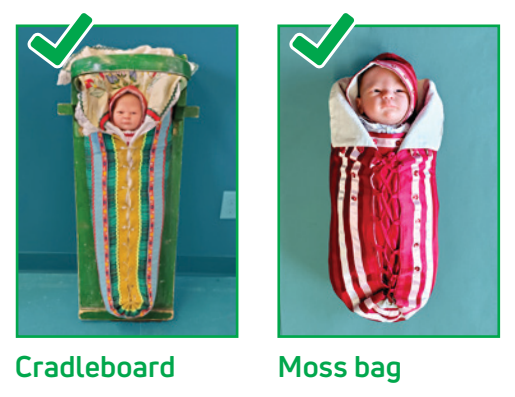
The safest place for a baby to sleep is in a crib, cradle or bassinet. Parents may also choose to use cradleboards and moss bags. Ask a Knowledge Keeper about safe use of cradleboards and moss bags.  

on the left, an infant inside of a colourful cradleboard. On the right, an infant inside a red and white moss bag. Both images have green check marks in the top left corner

Resources

What is Measles? 

Measles is an infection caused by a virus that spreads easily and can make you very sick. Measles is mainly spread through the air. You can catch measles when someone with measles coughs or sneezes, and the spray from their droplets land in your nose or mouth. The virus can live in the air for an hour or more, which means you can catch it by being in the same room with a person with measles or where someone with measles has recently been.

Measles is continuing to spread in Manitoba. Find more information here

Did you know?

In severe cases, measles can cause swelling of the brain, which is called encephalitis. This can lead to seizures, permanent brain damage, hearing loss or death. Measles occurring during pregnancy has been associated with miscarriage, premature delivery and babies born with a low birth weight.

What are the symptoms of measles?

  • Measles begins with a fever, aches and pains, a runny nose, a severe cough (often bronchitis — an infection of the airways) and very red eyes. You may think it is a cold. Symptoms can appear seven to 21 days after being exposed to the virus.
    close up of an adult with very red eyes
  • In a few days, a reddish blotchy rash begins around the face and head, then spreads down to the body, arms and legs. Bright light may cause eye pain.
    a blonde child lying in bed on their side, with their arm partially covering their face. A red rash is visible on their back.
  • Measles can cause an ear infection or pneumonia (a serious disease where breathing becomes difficult). 

Did you know?

Measles is very contagious four days before the rash starts and up to four days after. This is why it is important to stay home if you know you have been exposed to someone with measles.

What should I do if I think I or my child(ren) have been exposed to measles or have symptoms?

Avoid contact with others. Stay home from work, school or daycare. Call your health-care provider or local public health office for advice. If you are going to a clinic or hospital, tell the front desk staff that it might be measles and follow their instructions. To help prevent the spread of measles, you should not wait in the same waiting room as other people. 

Other ways to prevent spreading the virus are:

  • washing your hands frequently
  • covering your nose and mouth when you cough and sneeze
  • avoiding sharing personal items such as water bottles, lip gloss and cigarettes

Who are more likely to get very sick from measles?

  • Babies and young children
  • Pregnant people 
  • People with weakened immune systems

How can I protect myself or my children?

There is no cure for measles. You can protect yourself by making sure you are vaccinated. The measles vaccine is offered free of charge as part of Manitoba’s Recommended Routine Immunization Schedule.

Did you know? Babies six months to less than 12 months of age who live in, or are travelling to, areas of Manitoba where measles is spreading can get an additional dose of measles vaccine. For more information on vaccine eligibility visit: Vaccine Eligibility | Health | Province of Manitoba

If you or your child(ren) are eligible for the measles vaccine, appointments can be scheduled through your health-care provider or local public health office. A list of public health offices in Manitoba is available here. Please note that pharmacists do not administer publicly funded measles vaccines.

For general health inquiries, you can also call Health Links – Info Santé at 204-788-8200 or toll-free at 1-888-315-9257.

My baby cannot get the measles vaccine. Is there anything I can do to protect them?

Babies younger than six months of age cannot get the measles vaccine. Because of their young age, they can get very sick if they are exposed to the virus. Large events may expose people to measles, especially if they are held in areas where measles is spreading or where there have been several measles exposures. If your baby is too young to be vaccinated, you should think about this risk when deciding whether to go to large gatherings.  

Antibodies against measles can pass into breastmilk/chestmilk. This means that if you have been vaccinated or previously infected, breastfeeding/chestfeeding can help protect your baby from measles.

Did you know?

If you are not fully vaccinated against measles, pregnant or have a weakened immune system and you were exposed to the virus, call your health-care provider right away. Depending on when you were exposed, you could receive measles preventive treatment. This can protect you from measles infection or make the symptoms less serious.

References

Think you might be pregnant?

If you planned your pregnancy, finding out you are pregnant can be exciting news, but it also can be a time of uncertainty. If your pregnancy was unplanned you may want to know more about your options. Either way, you have come to the right place for information to help you make the best choice. 

Missed your period? Peeing more than usual? Have tender breasts? Feeling tired and nauseated? Do you think you could be pregnant? The only way to know for sure is through a positive pregnancy test. You can take a home pregnancy test or have a test done through your health-care provider.

When should I take a home pregnancy test?

An at home pregnancy test, provides the most accurate result one week after you have missed your period.

When should I seek prenatal care?

Getting early and regular prenatal care improves your chance of having a healthy pregnancy. Call to book an appointment as soon as you think you may be pregnant. Click here to see what options are available in Manitoba for your regular prenatal care.

Signs and symptoms of pregnancy

With this pregnancy, you may have none, some or all of these symptoms, which can range from mild to intense. You may find your experience different from that of your friends or family.

  • Late period or missed period: This is the most common sign of pregnancy. Your period stops because your body produces hormones that stop ovulation and the shedding of the lining of your uterus.
  • Tender (swollen) breasts: Your breasts may feel tender and sore. They may start to enlarge and your areolas (the area around your nipple) may also start to darken and enlarge. As your pregnancy progresses, your cup size may increase (due to increased fluids and milk production) as well as your band size (as your ribs expand to make room for your growing baby).
  • Peeing more often: This can be an early sign of pregnancy. Your pregnant body makes more blood to nourish your growing baby. This increase in fluids makes you pee more often.
  • Nausea and Vomiting: These common symptoms of early pregnancy are caused by your changing hormones. Despite being called morning sickness, it can occur any time of day. For tips to help with your morning sickness, see our article Morning sickness got you down?
  • Fatigue: Your changing pregnancy hormones may make you feel extremely tired in your first trimester. People often get their energy back in their second trimester, then often feel more achy and tired as they get closer to their due date. This is due to your changing pregnancy hormones.
  • Spotting and cramping, especially around the time you expected your period
  • Strong cravings or dislike of certain foods

Learning about the healthiest choices for you and your baby, whether your pregnancy was planned or unplanned, is very important. If you planned your pregnancy, finding out you are pregnant can be exciting news, but it also can be a time of uncertainty. If your pregnancy was unplanned, you may want to know more about your options. Either way, you have come to the right place for information to help you make the best choice for your experience.

Planned Pregnancy

You can start taking care of your unborn baby right away by:

Now is the time to connect with your health care provider.

Unplanned Pregnancy

For some people, an unplanned pregnancy is simply a welcomed change in life plans. For others, it can be quite an unwelcome shock. You are not alone, as many pregnancies are unplanned. For pregnancy counselling and supports, see Women’s Health Clinic for more information.

Abortion 

Making the decision to end your pregnancy can be very difficult. Abortion is safe and legal in Canada. You do not need the permission of a parent or partner to have an abortion. Speak to your health care provider as soon as possible to learn about the process and about the availability of abortion services. Seek help early because abortions should be done early on in pregnancy.

For more information, see the Women’s Health Clinic.

Adoption

Another option available is allowing another family to adopt your baby. Visit The Government of Manitoba to learn about the options in Manitoba.

Quick links:

References: