Managing Mastitis

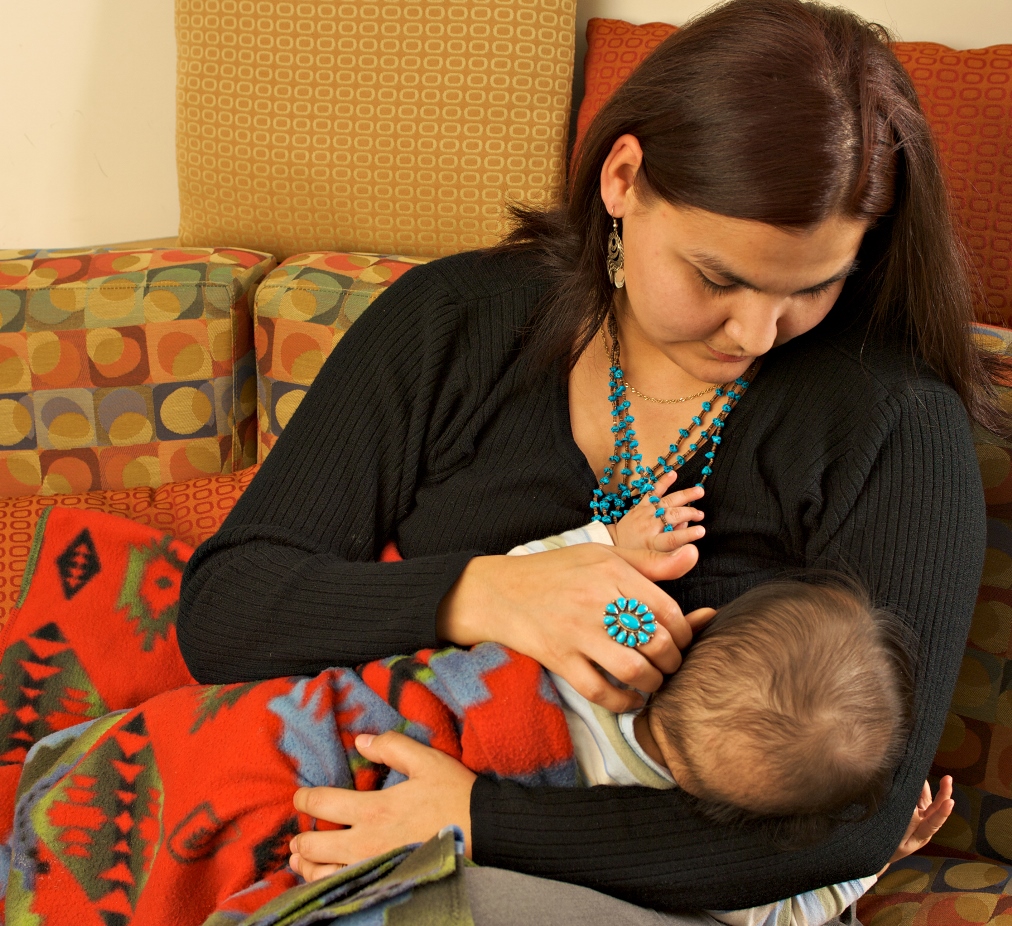
Mastitis is painful inflammation in the breast tissue that can affect parents who breastfeed/chestfeed or exclusively pump. Mastitis can cause pain, swelling, warmth and redness on your breast/chest.  It can also make you feel run down and tired. Parents can continue to breastfeed/chestfeed their babies while mastitis is healing. 

What are the symptoms of mastitis? 

  • red, warm or swollen breast/chest 
  • tender lump in your breast/chest 
  • nipple bleb or milk blister 
  • flu-like symptoms such as fever (greater than 38 C), chills, body aches 
Illustration of mastitis showing an inflamed breast cross-section labeled with fatty tissue, skin redness, inflammation above the nipple, nipple, lactiferous ducts and lobules.

What causes mastitis? 

Mastitis is most commonly caused by overactive milk production (hyperlactation) through over-pumping or medications used to increase breastmilk/chestmilk supply. Oversupply of milk causes the breast tissue to put pressure on the milk ducts, and may cause plugged ducts, engorgement and inflammation.  Skipped feeds, poor latch, a poorly fitting breast pump/chest pump flange or recent use of antibiotics can also lead to mastitis. In some cases, mastitis inflammation can lead to infection (bacterial mastitis) or an abscess (a collection of fluid and pus under the skin).

What can I do to ease mastitis?

What to do

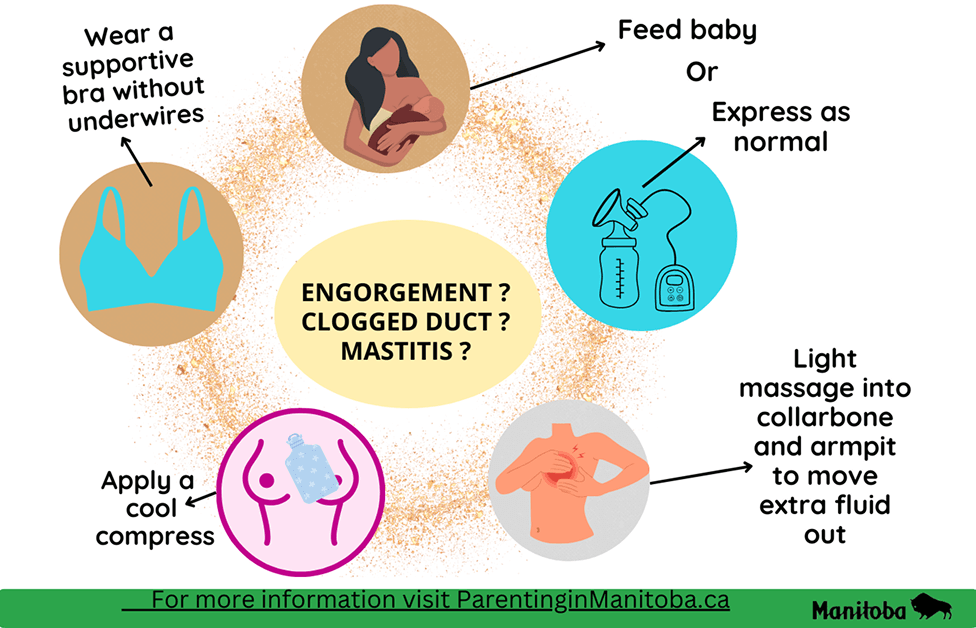
  • Feed your baby or express breastmilk/chestmilk as normal. 
  • Feed your baby at the breast/chest in your usual position. 
  • Apply a cool compress. 
  • Do gentle lymphatic massage. Watch this video to learn how. 
  • Take ibuprofen (Advil®, Motrin®) or naproxen (Aleve®) as needed. 
  • Wear a supportive and comfortable bra. 
  • Ask your health-care provider for a steroid cream for nipple blebs. 

What to avoid

  • Extra feeds or pumping to “empty the breast/chest” as this can increase swelling and inflammation. 
  • Feeding positions that are not recommended such as dangle feeding. 
  • Applying heat. 
  • Pushing on the lump or using vibration/electric toothbrush. 
  • Using saltwater (saline) soaks, castor oil or other topical products. 
  • Wearing tight fitting bras or bras with underwires. 
  • Picking the nipple bleb. 

If you were binding prior to pregnancy, you may already have stopped due to increasing chest sensitivity while pregnant. While you are breastfeeding/chestfeeding, wearing something less restrictive with more flexibility than a chest binder can be helpful in milk production and lower the risk for infections like mastitis.

Parent Tips 

  • Ask your family and friends for help so you can rest.   
  • If the recommendations above don’t improve your mastitis and you develop flu-like symptoms that last more than 24 hours, call your health-care provider. 

“I always heard you are supposed to empty your breasts/chest to help with mastitis…have things changed?” 

The new recommendation is: If you are separated from your baby or are exclusively pumping, aim to produce only the amount of milk your baby needs and not more. If you need help breastfeeding/chestfeeding your baby, reach out to your public health nurse, knowledge keeper, midwife or health-care provider. 

In the past, it was thought that “emptying your breasts/chest” more often would treat the symptoms of oversupply. New research (as of 2022) shows that this actually makes engorgement worse. Doing extra feeds or pumping will only lead to more milk production and more inflammation. 

How can I prevent mastitis?  

  • Breastfeed/chestfeed your baby based on their hunger cues. Make sure your baby has a good latch and position
  • Get help early if you have concerns about breastfeeding/chestfeeding. Check out our Breastfeeding Resources – Parenting in Manitoba page. 
  • Pump breastmilk/chest milk only if you have to be away from your baby or you plan to give a bottle instead of feeding at the breast/chest. 
  • If you are exclusively pumping, pump only the amount of milk your baby needs and not more. 
  • When using a breast pump/chest pump, use the most comfortable pressure setting and pump for 10 to 15 minutes. Make sure your breast pump/chest pump flange is the right size for you. 
  • Wear a good-fitting bra without underwires. It shouldn’t be tight or restrictive. 

Why do my breasts/chest feel like they are going to explode? 

  • In the early days of breastfeeding/chestfeeding, it is common for breasts/chest to swell up with milk. They may feel full, heavy and sore. This is called engorgement. You may mistake it for mastitis. 
  • Engorgement can also happen later on if feedings are missed. 
  • The good news is, engorgement generally only lasts a couple of days. 

Resources

References

Breastfeeding/Chestfeeding and Substance Use: What you Need to Know

Alcohol and Breastfeeding/Chestfeeding 

When you drink alcohol, it passes into your breastmilk/chestmilk. The safest choice is not to drink alcohol if you are breastfeeding/chestfeeding because: 

  • Drinking alcohol decreases your let-down reflex (it may take longer for your breasts/chest to release your milk).
  • Drinking alcohol does not increase your milk production as urban myth suggests. Your baby’s feeding determines how much milk you make
  • Babies may not like the taste of breastmilk/chestmilk containing alcohol which could make them drink less.
  • Very young babies have immature organs which makes it harder for them to clear the alcohol from their bodies.
  • Alcohol may affect your baby’s sleep. 
  • You may fall asleep, or you may be too drowsy to care for your baby. 

How long does alcohol stay in my breastmilk/chestmilk? 

On average it takes two to three hours to clear one standard size drink from your body.  

How fast your body gets rid of alcohol depends on: 

  • the amount of alcohol you drank
  • how fast you drank it
  • whether you have eaten food
  • how much you weigh
  • how fast your body processes alcohol

Do I have to pump and dump after drinking an alcoholic beverage? 

No. As alcohol leaves your bloodstream, it leaves your breastmilk/chestmilk.Pumping and dumping, drinking a lot of water, resting or drinking coffee will not speed up how quickly your body gets rid of the alcohol. 

Can I have a drink and still breastfeed/chestfeed? 

Mothers who only drink once in a while should continue to breastfeed/chestfeed, because the benefits outweigh the risks. Here are some ways to make it safer for your baby: 

  • It is best to plan ahead if you are going to have a drink
    • Pump and store breastmilk/chestmilk a couple of hours before an event where you may drink alcohol to have it ready to feed your baby. Ensure you will have enough expressed milk to cover the amount of time you will have alcohol in your system 
  • Limit yourself to one drink or less per day. 
  • Drink alcohol after breastfeeding/chestfeeding (not before). 
  • Wait two to three hours per drink before breastfeeding/chestfeeding again to allow time for the alcohol to clear from your breastmilk/chestmilk and body. 
  • Invite your partner to limit their alcohol use to support you. 

Did you know?

Babies feed often in the first three months and during growth spurts. These are good times to limit your alcohol intake. 

For more information on alcohol and breastfeeding/chestfeeding, see Best start’s Mixing Alcohol and Breastfeeding. 

For more information on breastfeeding/chestfeeding, see our other breastfeeding/chestfeeding articles.  


Tobacco and Breastfeeding/Chestfeeding 

The healthiest choice for your baby is to breastfeed/chestfeed and for you to avoid tobacco use. If you can’t stop or cut down, breastfeeding/chestfeeding is still recommended. Breastmilk/chestmilk gives your baby antibodies to help fight illness. It can also help lessen some of the negative effects of tobacco on your baby. 

If you choose to smoke while breastfeeding/chestfeeding follow these tips to help protect your baby:  

  1. Do not smoke right before or during breastfeeding/chestfeeding. 
    This way there will not be as much nicotine in your milk and your baby will not be exposed to secondhand smoke. 
  2. Try to cut down. For support with quitting or cutting down visit Smoker’s Helpline and/or talk to your health-care provider or public health nurse. 
  3. Wait as long as possible between smoking and breastfeeding/chestfeeding. 
  4. Keep your home smoke free. Smoke outside, away from your baby and other children. Do not allow anyone else to smoke near your baby. 
  5. Protect your baby from thirdhand smoke. Wash your hands and change your clothes after you smoke and before you hold your baby. Have family members/friends do the same. 

For more information on tobacco use, see Tobacco Use: Know the Facts.


Cannabis and Breastfeeding/Chestfeeding 

When you use cannabis the active chemical, called THC, is stored in your fat cells (like your brain and breast tissue). When your baby breastfeeds/chestfeeds, THC is passed through your breastmilk/chestmilk and it enters your baby’s brain and body, where it can remain for weeks. 

When a baby is exposed to cannabis through breastmilk/chestmilk, the effects are similar to when a baby is exposed during pregnancy. The baby may have sleep problems, be fussier and startle easily. As the baby grows, they may have problems with memory, reasoning, focusing and be easily distracted. 

  • The healthiest choice for your baby is to avoid cannabis use while breastfeeding/chestfeeding. For more information on breastfeeding/chestfeeding your baby, see our other breastfeeding/chestfeeding articles.
  • If you choose to use cannabis while breastfeeding/chestfeeding despite the risks, use as little as possible. 

Safety Tip

Avoiding or reducing alcohol, smoking and cannabis is healthier for your baby and reduces the risk of accidental injury, Sudden Infant Death Syndrome (SIDS) and other causes of sudden infant death. Place your baby on their back in a safe sleep space after using substances rather than bed-sharing or sharing a sofa or chair. 

What is Diastasis Recti? And can I still exercise?

Diastasis recti is a separation of the stomach muscles and is fairly common. It can occur at any time, but usually happens in the last trimester and after you have your baby. 

What causes it? 

During pregnancy, your abdomen gets bigger as your baby grows.   

The hormone (relaxin) that causes your muscles to relax for childbirth increases. 

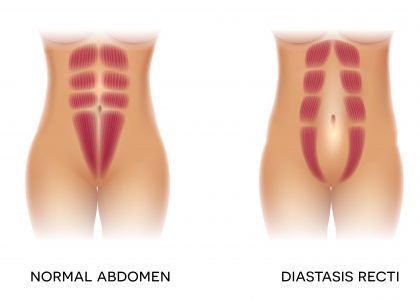
The band of muscle that holds the left and right side of your abdominal muscles together is called the linea alba. Your relaxed muscles and the pressure of your growing uterus causes the linea alba to soften and widen. This is called diastasis recti. 

The picture below shows normal abdominal muscles and diastasis recti. 

A side by side of "normal" abdomen muscles and muscles with diastasis recti. The image on the right shows a separation of muscle down the middle of the abdomen.

How do I know if I have diastasis recti? 

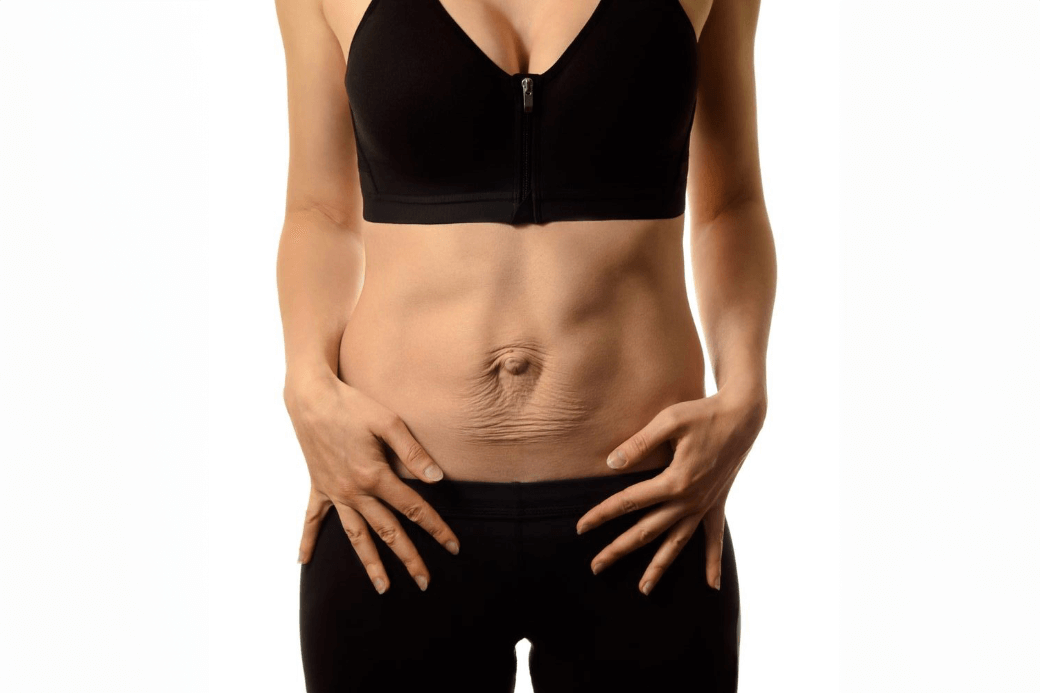
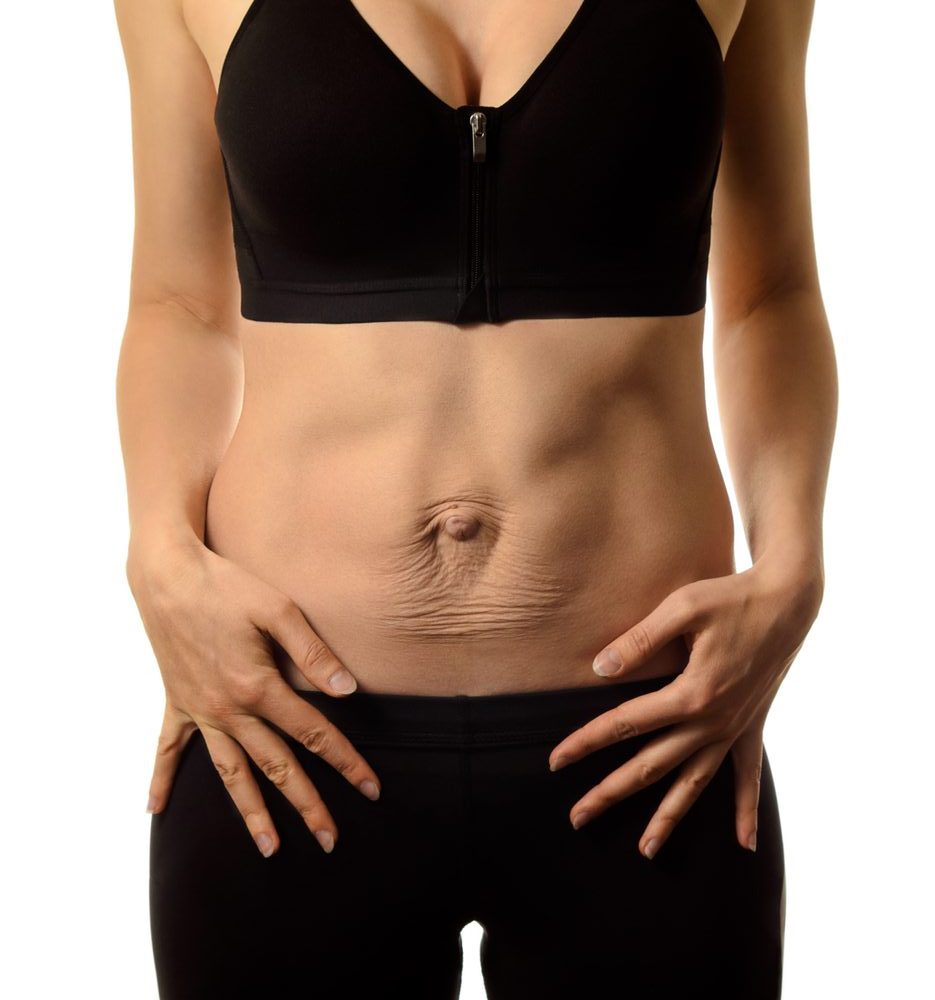
You might notice a separation, ridge or dip in the middle of your abdomen. It can start just under your breastbone and extend to below your belly button. The picture below shows a significant separation. 

Photo of an abdomen showing a separation of abdominal muscles

How to check yourself for diastasis recti: 

  • Lie on your back with your knees bent and your feet flat on the floor. 
  • Place your fingertips just below your belly button. Your palm should be facing your head. 
  • Gently lift your head and shoulders off the floor. 
  • Feel how far apart your left and right abdominal muscles are.
  • Measure the amount of separation using your finger widths. (For example, one, two finger widths) 
  • A gap of more than two and a half finger widths is considered a big gap. 

Why it’s important to treat diastasis recti? 

Having diastasis recti means that your abdominal wall is weak. This can affect the strength of your stomach and back muscles which can cause lower back pain. It can also weaken the pelvic floor muscles that support your bladder, rectum and uterus. 

With weak pelvic floor muscles you may: 

  • Leak urine 
  • Have pain during sex 
  • Have organ prolapse 

If you think you have diastasis recti: 

  • Talk to your health care provider. 
  • Talk to a physiotherapist (There are physiotherapists in Manitoba who specialize in pelvic health).
    • Your physiotherapist can give you specific exercises to help close your separation 

Can I still exercise? 

Yes, you can still exercise! However, exercises that push your stomach muscles out can increase the separation and should be avoided. Some examples of exercises to avoid are: 

  • Abdominal strengthening exercises such as curls, crunches, obliques, sit-ups, “bicycles” 
  • Abdominal stretching exercises such as yoga poses – “cow pose,” “up-dog,” all backbends and “belly breathing” 
  • Lifting anything heavier than your baby  

References and links 

Immunization: Birth to Five

Immunizations are one of the best ways to protect you, your family and your community. Your baby will start getting immunizations at two months of age. Depending on where you live in Manitoba, your health-care provider or public health nurse will give your baby their immunizations. If you do not have a health-care provider, use the Family Doctor Finder.

Immunizations:

  • are safe and effective 
  • protect against diseases caused by germs such as bacteria or viruses 
  • are also known as a shot, needle, booster, vaccine or vaccination 

What vaccines should my child get? 

See Routine Immunization Schedules – Province of Manitoba for the most up to date information

Some vaccines need more than one dose to:

  • Build immunity to prevent the disease.
  • Boost immunity that can weaken over time.
  • Protect against germs that change over time, like the flu.

Immunization Records:

You can get your immunization record by submitting a request via the e-form https://forms.gov.mb.ca/immunization-update-request/

You may also be able to get a copy by:

  1. Contacting your local public health office,
  2. Checking if your local medical clinic or physician’s office can provide them to you, or
  3. Asking at a local nursing station or health centre.

If your child has missed any of their vaccines, see Immunization Schedules for Individuals NOT Previously Immunized – Province of Manitoba 

All people in Manitoba who are six months old and older are encouraged to get their free flu vaccine and keep up with all recommended shots. You can get the flu vaccine at the same time as other vaccines, including the COVID-19 vaccine. This vaccine is especially important for people who are at higher risk of getting COVID-19 or becoming very sick, as well as their caregivers and close friends and family. 

Even if you’re not at higher risk, you can still get the COVID-19 vaccine.  

For COVID-19 immunization information visit: COVID-19 – Province of Manitoba and Protect Our People MB

Preparing for Your Child’s Vaccine Appointment 

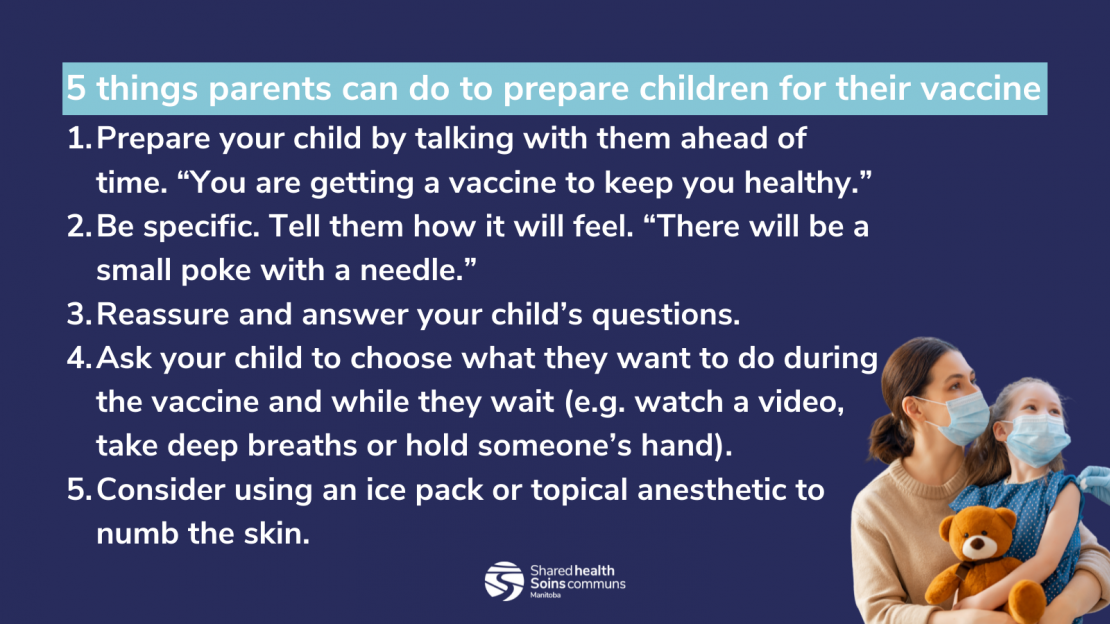
A list of five things parents can do to prepare children for their vaccine, with the Shared Health logo and a photo of a masked parent holding a masked child on their lap. 1. Prepare your child by talking with them ahead of time. “You are getting a vaccine to keep you healthy.” 2. Be specific. Tell them how it will feel. “There will be a small poke with a needle.” 3. Reassure and answer your child’s questions. 4. Ask your child to choose what they want to do during the vaccine and while they wait (e.g. watch a video, take deep breaths or hold someone’s hand). 5. Consider using an ice pack or topical anesthetic to numb the skin
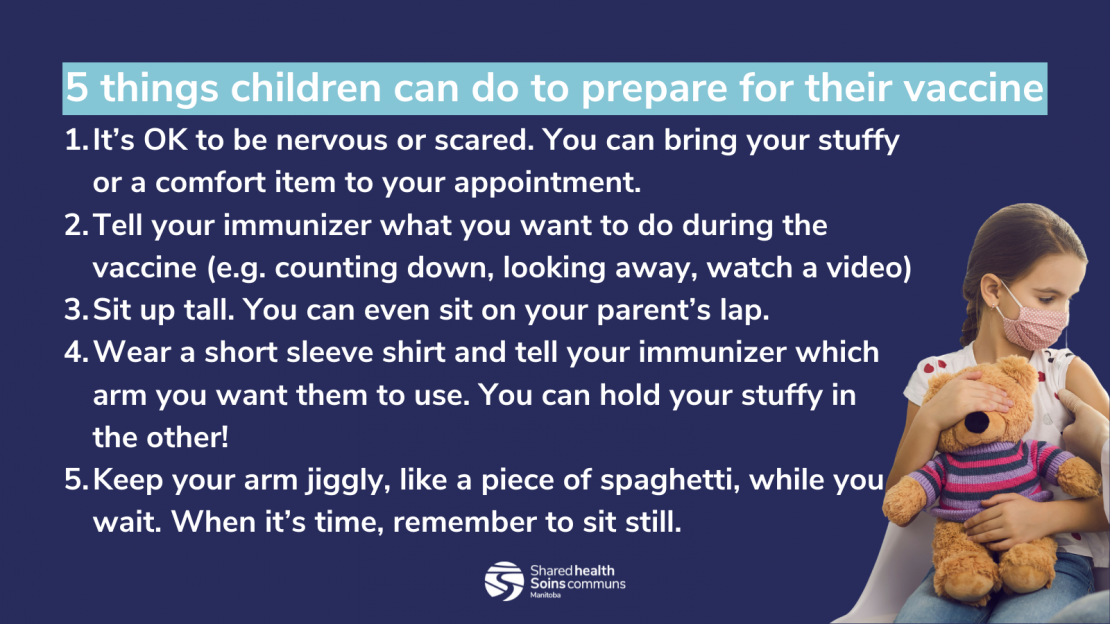
A list of five things children can do to prepare for their vaccine, with the Shared Health logo at the bottom and a photo of a child wearing a mask and holding a teddy bear as they receive a vaccine, with the needle just out of frame. 1. It’s OK to be nervous or scared. You can bring your stuffy or a comfort item to your appointment. 2. Tell your immunizer what you want to do during the vaccine (e.g. counting down, looking away, watch a video). 3. Sit up tall. You can even sit on your parent’s lap. 4. Wear a short sleeve shirt and tell your immunizer which arm you want them to use. You can hold your study in the other! 5. Keep your arm jiggly, like a piece of spaghetti, while you wait. When it’s time, remember to sit still.

Preparing Your Child for their Vaccine from Shared Health on Vimeo. Note: Other videos may be recommended by the host channel (e.g. YouTube, Vimeo).  These suggestions may be based on your personal search history and other factors. The WRHA does not control these suggestions and is not responsible for and may not endorse the content.

Did you know?

  • Breastfeeding/chestfeeding your baby while they are being immunized may help soothe them. 
  • Holding your child close and distracting them with singing or talking can also help. 
  • You can try to distract an older child with toys such as bubbles, pop-up books, puppets or rattles. 
  • For more tips to help your young child cope with immunizations, click here. 

References:

Free Sessions – Feeding Your Baby Solid Foods

Are you interested in a free session that teaches you how to introduce solids to your baby?  WRHA Public Health Dietitians are offering a monthly live, online class for parents, caregivers, family members and friends. This workshop provides the most up-to-date information on introducing solid foods to your baby. The following topics are covered in the video and workshop: 

  • When to introduce solid foods 
  • Helping your baby develop healthy eating habits 
  • Your baby and family foods 
  • Making mealtime enjoyable and stress-free 

For the 2026 schedule and registration information click here.

If you are not able to attend an online session, these resources are available: 

Other free programs 

For more community supports and programs, see Community Public Health Resources for Families 

Questions? 

If you have a nutrition or food question, call Dial-a-Dietitian Manitoba at 204-788-8248 in Winnipeg or 1-877-830-2892

For more credible nutrition information, follow the WRHA dietitians at WRHA Nutrition on Facebook! 

Breastfeeding/Chestfeeding Resources

Additional Breastfeeding/Chestfeeding Resources 

If you have any questions about breastfeeding/chestfeeding call: 

  • Your local public health nurse , nursing station, health centre, health-care provider 
  • Health Links-Info Santé – 204-788-8200, toll-free 1-888-315-9257. You can speak to a nurse 24/7, 365 days of the year in over 100 languages. They can answer your health questions and help you find health services in your community. 
  • Your health care provider to ask about a referral to a breastfeeding/chestfeeding medicine doctor.  

Dial-a-Dietitian

If you have a nutrition or food question, call Dial-a-Dietitian Manitoba at 204-788-8248 or toll-free at 1-877-830-2892

Keeping your baby warm in winter

In the winter you will want to make sure that your home is warm enough for your baby but not too hot.

In your Home

  • Dress your baby as you would dress yourself. If you are comfortable in pants and a light sweater, your baby will be too.
  • The temperature in your home should be:
    • at least 21°C in the day (7a.m. to 11 p.m.).
    • no lower than 18°C at night (11 p.m. to 7 a.m.)

Did you know?

If you rent, you can ask your landlord to follow these recommendations. If your landlord does not comply, you can call the Residential Tenancies Branch at 204-945-2476 or toll free 1-800-782-8403.

In the Crib or Bassinet

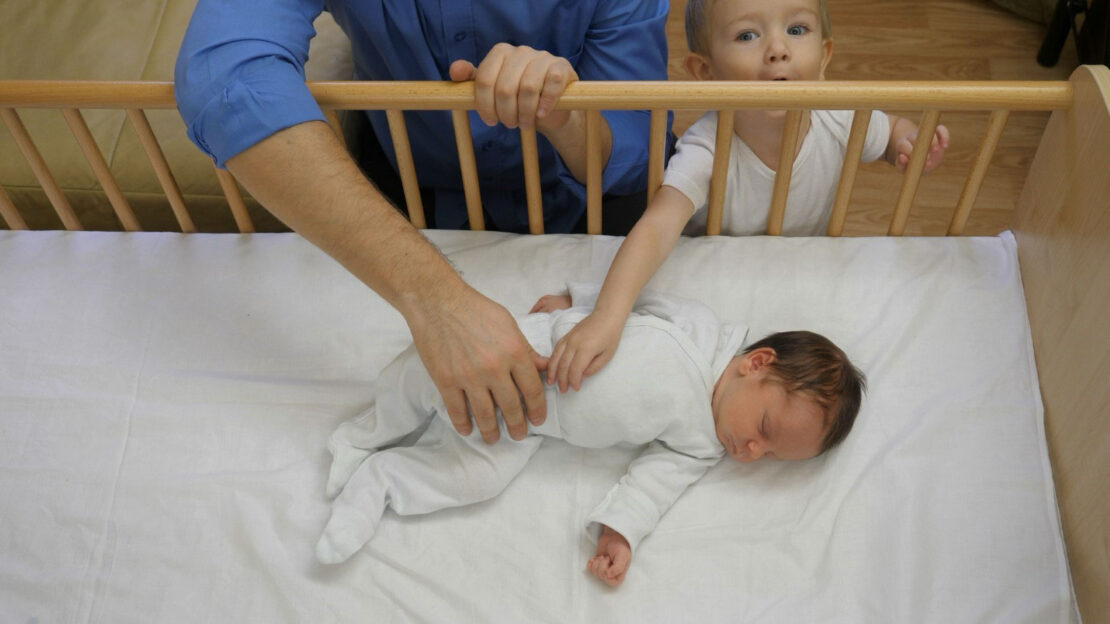
a baby in a white onesie sleeping on their back in a crib. An adult and a toddler are reaching in to gently touch them

The safest place for a baby to sleep is in a crib, cradle or bassinet in your room for the first six months, or ideally, for the first year.

  • Dress baby in one-piece footed sleepers. For an extra layer, use a onesie or undershirt.
  • Use a flannel fitted sheet in your baby’s crib.
  • Crib or bassinet should not be near radiators, heaters, fireplaces and woodstoves, windows, drafts and outside walls.
  • Babies may need a hat to stay warm if the room is too cold.
  • Do not use hot water bottles or electric blankets, these could cause a burn or your baby to overheat.

If baby is still cold and you want to use a blanket in a crib

Use a crib-sized blanket.  It should be large enough to be firmly tucked in without coming loose, but small enough so it does not make the mattress uneven when tucked in.

  • Lay baby on back with feet near the bottom of the crib.
  • Place blanket so that it is no higher than baby’s armpits.
  • Tuck the blanket into the sides and bottom of the crib.

Out and about

Dress your baby for the weather

  • Keep your baby warm by dressing them in layers that are easy to put on and remove.
  • Mitts, socks, boots will help keep your baby warm.
  • A warm hat is important because babies lose a lot of heat through their heads.
  • When you go indoors remove or at least unzip baby’s snowsuit and take off the hood or hat to prevent overheating.

Did you know?

When using a stroller or sled, exercise can make you feel warm, though your baby is just sitting and will feel the cold much more than you.

Winter Car Seat Safety

Here are some tips to keep your child warm and safely buckled in their car seat.

As a general rule, infants should wear one more layer than adults. If you’re wearing a coat, your baby will likely need a coat and a blanket, too. Just remember to take off the coat and blanket once you’re inside the car before buckling your child into the car seat. A safer option is to drape a blanket or coat over the car straps after your baby is buckled in.

Your baby needs to be dressed warmly in the winter.  Choose a snowsuit that isn’t puffy or made from slippery material. Take care that your baby’s snowsuit or other clothing doesn’t interfere with the fit of the car seat:

When clicking your baby in:

  • Only one finger should fit between the car seat straps and your baby’s collarbone.
  • The chest clip should be at armpit level.

If you are using a blanket: 

  • Make sure it is no higher than baby’s armpits
  • Never place the blanket behind or under baby.

If you are using an infant car seat cover:

  • Only use the infant car seat covers briefly when taking baby outside.
  • Remove the cover as soon as you are inside or in the vehicle.
  • Only use the car seat covers that go over the car seat. Do you use the ones that go under your baby.

How to tell if your baby is cold

  • Feel their under their armpits, or their thighs if they are cold. Cold hands and feet do not always mean that the baby is cold.
  • They are fussy
  • Their skin looks pale or blotchy

To warm your baby

  • Hold Them Close – skin to skin is best
  • Add Layers – Start with close-fitting layers like a onesie and then add a blanket or a warm sleeper. Make sure the blanket is not too tight around their chest and always leave their face uncovered.  
  • Adjust the Room Temperature you may need to turn room temperature up

References

Is it a cold, the flu or COVID-19?

What is a cold? 

A common cold is most often caused by rhinoviruses, an illness which affects the nose, throat and sinuses. Cold symptoms are usually mild and often include a runny or stuffy nose.  There are many different cold viruses, so your child may have eight to 10 colds in a year. 

What is the flu (influenza)? 

The flu is a respiratory infection caused by influenza viruses. In Manitoba, flu season usually begins in the fall and lasts into the spring. Symptoms are generally more severe than the common cold and can include sudden high fever, body aches, extreme tiredness, sore throat and dry cough. Young children may also have nausea and an upset stomach.  

What is COVID-19? 

COVID-19 is caused by the SARS-CoV-2 virus, a virus in the coronavirus family. Most people infected with the virus will experience mild to moderate respiratory illness. Some may become seriously ill and require medical care. COVID-19 can cause symptoms that are similar to a cold or the flu. 

How is a cold, the flu or COVID-19 spread? 

Colds, the flu and COVID-19 are all caused by viruses (germs). They are spread from one person to another when the germ gets into the mouth, nose or eyes. This can happen when: 

  • coughing
  • sneezing
  • kissing
  • holding hands 
  • touching used tissues, toys and other surfaces 

Common signs and symptoms of colds, the flu and COVID-19 

Common Symptoms*ColdFluCovid
Fever and/or chills
Headache
Muscle pain and body aches
Feeling tired or weak
Sore throat
Runny or stuffy nose
Sneezing
Cough
Shortness of breath or difficulty breathing
*Symptoms may vary based on new COVID-19 variants and vaccination status 

Adapted from Common Symptoms of a Cold, the Flu and COVID-19 – The National Institute on Aging. 

What should I do if I think my child has a cold, the flu or COVID-19? 

  • A cold, the flu and COVID-19 are all caused by viruses. They will last a few days to a few weeks and go away on their own. Antibiotics will not help. 
  • If your child is sick, you should keep them comfortable and care for them at home. 
  • Children with chronic diseases, cancer and those taking medications that suppress the immune system should contact their doctor if they have symptoms of influenza or COVID-19.  
  • For advice about when your child should see a doctor, click here

Tips for comforting your sick child: 

  • Make sure your child gets plenty of rest and fluids. 
  • Gargling with warm salt water can help soothe a sore throat. 
  • If your child has a fever, dress them in light clothing and remove any extra blankets. For managing fever, see our page:  Kid’s Fever: What to Know, When to Get Help. 
  • For information about fever medicine, cough and cold medicines and medicated nose sprays, see our page: Over the Counter Medication and Children
  • Colds, the flu and COVID-19 cannot be treated with antibiotics. Antibiotics should only be used when children develop bacterial infections, such as an ear infection or pneumonia. 
  • Use saline (salt water) drops to help clear a stuffy nose. If your infant is having trouble feeding because of a stuffed nose, you can use nose suction products such as a nasal aspirator or bulb suction. Use saline nose drops or saline nose spray if the mucus is very thick. The spray goes well into the nasal passages and may be easier to use and may work better than the drops. 
  • Try a cool mist humidifier. This can help clear a stuffy nose more comfortable. Be sure to clean and dry the humidifier to prevent bacteria or mould buildup. 

Used with permission from the Hospital for Sick Children Note: Other videos may be recommended by the host channel (e.g., YouTube, Vimeo). These suggestions may be based on your personal search history and other factors. The Manitoba government does not control these suggestions and is not responsible for and may not endorse the content.  

How is a cold, the flu or COVID-19 diagnosed? 

  • To diagnose a cold or the flu, your health-care provider will examine your child and ask about their signs and symptoms. They may also do a nose and throat swab to test for the influenza virus if your child has a serious medical condition such as cancer or is being admitted to the hospital. 
  • For information on COVID-19 testing, see COVID-19 Testing Advice and Guidance – Government of Manitoba

How to prevent the spread of a cold or the flu 

  • If your child has symptoms of a respiratory infection, follow public health guidance to help limit the spread of viruses to others.  
  • Have your child vaccinated for all recommended illnesses including the seasonal influenza vaccine (the “flu shot”) and the COVID-19 vaccine. The flu vaccine is safe for any child over six months of age and it is suggested your child gets it every year.
    • It is also important for parents, family members and caregivers of your child to get vaccinated for the flu so that they do not spread the flu.  
  • To learn more about vaccine preventable respiratory illnesses, visit Manitoba.ca/vaccine  
  • Wash your and your child’s hands with soap and water after coughing, sneezing or wiping a nose. To learn more see Hand Hygiene – Government of Manitoba.
    • Sing your child’s favourite song while washing their hands to make sure they are washing long enough. 
  • Cough and sneeze into the inside of your elbow or into a tissue instead of your hands. Teach your child to do this too! To learn more, see: Cover your Cough and Sneeze – Government of Manitoba
  • Keep your child home from daycare or school when they are sick to prevent spreading germs to other people. 
  • Teach your child not to share items that may be dirty with germs such as cups and eating utensils. 

For more information: 

Kids’ Fevers: What to Know, When to Get Help

Most children will get a fever at some point. This can feel scary for parents. 

If you think your child has a fever, you may wonder: 

  • How do I know for sure? 
  • How can I keep my child comfortable? 
  • When should I seek health care? 

What is a fever?  

  • A fever is a sign your body is fighting an infection and is not dangerous.
    • Normal body temperature is about 37 C (98.6 F). 
    • A fever is when your body temperature is 38 C (100 F) or higher. 
  • Fevers are most often caused by infections. Your child may have other symptoms such as earache, sore throat, rash or stomachache. 
  • It is common for children to have a low-grade fever up to two days after an immunization

How do I know if my child has a fever? 

A child with a fever may: 

  • have red cheeks or pale skin 
  • feel very hot and sweaty or cold and shivery (or both) 
  • be more fussy or tired than usual 
  • not want to eat (loss of appetite) 
  • be more thirsty than usual 
  • feel hot to touch on the face or body but have cold hands and feet 

How do I take my child’s temperature? 

  • The safest way to take a young child’s temperature is to hold a digital thermometer under the armpit. 
  • Once your child is over two years of age, you can use an ear thermometer. 

Safety Tip

Do not use a mercury thermometer.  If it breaks, it can expose your child to mercury, which is poisonous. 

How do I care for my child with a fever? 

Keep your child comfortable by: 

  • Keeping them hydrated by offering plenty of fluids or breastfeeding/chestfeeding 
  • Removing extra blankets and clothing 
  • Dressing your child in light clothing: diapers or underwear and a light shirt to allow the extra heat to escape from your child’s body. 

Did you know? 

If cooling your child is making them shiver, this can increase the fever. Things to avoid doing: 

  • sponging your child with cold water 
  • giving your child a cold bath or ice bath 
  • using ice packs 

Does my child need medicine to lower the fever? 

  • When your child’s body is fighting an infection, they may get a fever. 
  • Your child does not need medicine to bring down the fever. However, a child with a fever may be cranky, sleepy and not want to eat or drink. Fever medication can be used to help your child feel more comfortable, alert and more likely to drink. 
  • Acetaminophen (Tylenol®, Tempra®) or ibuprofen (Advil®, Motrin®) are the medicines that can be used to reduce your child’s aches and pains from the fever and illness.
    • How much you give is based on your child’s age and weight. 
    • Follow the medicine’s directions for how much and how often you can give the medicine to your child. 

Safety Tips

To avoid giving your child too much medication: 

  • Use only the measuring syringe or cup that comes with the medicine. Kitchen spoons are not all the same and can cause overdosing. 
  • Make note of the time and amount you gave. Tip – your calendar or phone works great for this. 
  • Write clear instructions for other caregivers about your child’s medicine. (What medicine, how much and when). 

To keep your kids safe: 

Put all medicine away after every use, even if you are going to be using it again soon. Store it out of sight and out of reach of children

Choose the right medication for your child: 

  • Do not give acetylsalicylic acid (ASA, Aspirin®) to children because it can cause a rare and dangerous disease called Reye’s Syndrome. 
  • Do not give ibuprofen if your child is dehydrated, vomiting or has diarrhea because it can harm the kidneys. 
  • Do not give over-the-counter cough and cold medicines to children under six. 
  • Check with your pharmacist if your child is taking two or more medications to make sure it is safe. 

Call your local pharmacist or Health Links – Info Santé (Winnipeg 204-788-8200, toll-free 1-888-315-9257) for information. 

When should I seek health care? Where should I go? 

Call 911 or your local emergency number if: 

  • your child is having a seizure 
  • you cannot wake up your child 
  • your child is having severe difficulty breathing or is turning blue 

Go to your local emergency department or nursing station, or call Health Links – Info Santé at 204-788-8200 or toll-free 1-888-315-9257 if your child has a fever AND: 

  • is less than three months old.
  • has had a seizure today (child does not respond to you and may be stiff or have jerking movements) 
  • has difficulty breathing or is wheezing 
  • is immunocompromised (neutropenia, transplant, steroids, has no spleen) 
  • doesn’t seem like themselves
    • is very cranky, fussy or irritable. 
    • is very sleepy or does not respond to you 
  • has a headache or sore neck that does not go away with pain medicine 
  • has cool skin that looks pale, grey or mottled 
  • develops a rash that looks like bruises or small red or purple dots that do not go away when you apply pressure with your fingers 

Go to your child’s health-care provider or walk-in clinic, urgent care, nursing station or community health centre today if your child has a fever and: 

  • is older than three months old and:
    • looks unwell 
    • has no energy 
    • symptoms do not improve with fever medicine 
  • may be dehydrated:
    • throwing up a lot 
    • is not drinking fluids 
    • has a dry mouth 
    • is not peeing 
  • has a new rash or sore throat 
  • has an earache that does not go away with pain medication 
  • has symptoms of a kidney or urinary infection (pees more often than usual and it hurts to pee) 

Contact your child’s health-care provider if your child has a fever and: 

  • The fever has lasted for more than three days (72 hours) 
  • The fever went away for 24 hours and then returned 
  • Is being treated for a bacterial infection and the fever is not going away after two to three days of being on antibiotics 
  • Your child recently had surgery 
  • Your child has a chronic medical condition 
  • Your child’s immunizations are not up to date 
  • You have recently returned from travelling outside of Canada. 

If you do not have a health-care provider, Family Doctor Finder can help. 

Do you still have questions?  

Call Health Links – Info Santé (Winnipeg 204-788-8200, toll-free 1-888-315-9257). You can speak to a nurse 24/7, 365 days of the year in over 100 languages. They can answer any of your health questions and help you find services in your community. 

What to do if a seizure occurs 

In some cases, seizures can happen with a fever. This is known as a “febrile seizure.” Not all seizures cause stiffness or jerking movements of the arms and legs. Some seizures look like “passing out.” If your child develops a seizure: 

  1. Stay calm. 
  2. Place your child on a flat surface on their side. 
  3. Do not move them unless they are near something dangerous. 
  4. Do not restrain them (do not hold them down). 
  5. Wipe away any vomit or saliva outside their mouth, but do not put anything between their teeth. 
  6. After the seizure stops, keep your child on their side. 
  7. Call 911 for further instructions. 
  8. On the same day, take your child to their doctor for a check-up. 

Do I need to keep my child home? 

If your child is prescribed antibiotics, ask the doctor when the child can return to school or daycare. 

References: