Formula Feeding Your Baby

Deciding how to feed your baby may come with a lot of questions. You may feel overwhelmed with the amount of information there is. If you are trying to decide and want more information on breastfeeding/chestfeeding see our article, Breastfeeding/Chestfeeding – Good for Baby, Good for You.

If formula feeding is part of your plan for your healthy, full-term baby, this information is for you. Ask your health-care provider about what type of formula is best if your baby: 

  • is premature 
  • is ill 
  • had a low birth weight 
  • has special needs

How to choose an infant formula 

  • There are many types and brands of formula on the market. Choose what works best for your situation unless your health care provider says your baby needs a special formula. Do not choose a formula based on advertising or the brand they gave you in the hospital. 
  • All formulas must meet safety standards set by Health Canada. The law requires that all brands of regular formula have the same basic ingredients. 
  • For most babies, a cow’s milk-based, store-bought infant formula with iron is best. Always check the label for the type of infant formula you are buying for your baby. 
  • Formula with prebiotics, probiotics or DHA and ARA fats added are available. However, the research is mixed about whether these types of formulas are beneficial for all babies. 
  • Organic formula is not necessary. Parents may choose it for personal reasons. 
  • Formula with “partially broken down” proteins is not needed by most infants but may be recommended by a health-care provider for some medical conditions. 
  • When buying formula, check the expiry date on the package. Do not use formula that is expired. 
  • Never buy formula if the container is damaged, dented, unlabelled or bulging. 
  • Formula-fed babies need to stay on infant formula until they are nine to 12 months of age. “Follow-up” formula is not needed. 

Did you know?

 All breastfed/chestfed and formula-fed babies need a vitamin D supplement

Do not use… 

  • homemade formula 
  • cow’s milk or goat’s milk 
  • plant-based beverages made from almonds, cashews, soy, rice or other plants

Note: Soy-based infant formulas are recommended for babies with some medical conditions, and some parents may decide to use soy formulas for personal, cultural or religious reasons. Discuss this with your health-care provider. 

There are three types of infant formula 

  • Ready-to-use – It really is ready to use. You do not need to add anything to it. This type is generally the most expensive. 
  • Concentrated liquid – You need to add sterile water according to the directions on the package. This type is also more expensive. 
  • Powder – This is the least expensive type of formula. Unlike the others, powdered formula is not sterile. It is not recommended for babies who:
    • are born premature (less than 37 weeks gestation) and are under two months of age 
    • are born with a low birth weight (under 2.5 kilograms) and are under two months of age 
    • have a weakened immune system 

If you’re unsure, talk to your health-care provider before giving powdered formula to your baby. 

Formula Comparison Chart

Formula

Preparation

Cost

How to store container after opening

How long open container can be stored

Powder *Powdered infant formula is not sterile

Boil water for two minutes Add powder to water while it is still over 70°C and follow mixing instructions that come with your powdered formula

Least expensive

Covered in a cool dark place

Less than 30 days

Liquid concentrate

Boil water for two minutes Let water cool Mix equal amounts of water and liquid concentrate

More expensive

Covered in fridge

Between 24 to 48 hours. Check the formula container for the different formula recommendations.

Ready-to-use

Use as is

Most expensive

Covered in fridge

Between 24 to 48 hours. Check the formula container for the different formula recommendations.

Do not mix different types or forms (such as powdered and concentrate) of formula together when preparing bottles unless directed by your health-care provider.

More things you need to know about formula feeding 

Feeding your baby is more than providing nourishment. It’s also a time to learn about your baby and connect with each other. This helps your baby grow and develop. Skin-to-skin contact during feeding has many benefits, including calming your baby and helping them feel safe and secure. 

two adults smiling and holding their baby

References

Thinking About Getting Pregnant? Take Folic Acid

Did you know that taking a folic acid supplement at least three months before pregnancy can help prevent a serious health condition called neural tube defect in your baby? A neural tube defect (NTD) is a serious health condition that affects your baby’s brain and spinal cord. Taking a folic acid supplement can help prevent NTDs in your baby. Most NTDs happen in the first four weeks of pregnancy, often before you know you are pregnant. This is why people who could become pregnant (adults and teens) should consider taking a daily multivitamin containing 0.4 mg of folic acid. 

What is folic acid? 

Folic acid (also known as folate or folacin) is a B vitamin. Foods rich in folic acid include some grains, green vegetables (spinach, broccoli), meats (liver) and legumes (lentils and kidney beans). Although it’s found in these foods, it can be hard to get enough folic acid from diet alone. Folate is essential to the normal development of your baby’s spine, brain and skull, especially during the first four weeks of your pregnancy. It helps your baby’s neural tube develop properly during pregnancy and protects against neural tube defects (NTDs). It may also lower the risk of other problems, such as cleft lip and palate or heart and urinary tract defects. 

What is a neural tube? 

A baby’s central nervous system starts to develop early in pregnancy. When that happens, a neural plate forms, which eventually folds in on itself and becomes the neural tube. One end of the neural tube forms the brain, and the rest forms the spinal cord. By week six of a pregnancy, the openings in the neural tube usually close. 

What is a neural tube defect? 

Neural tube defects happen when one of the openings in the spinal cord does not close properly during early pregnancy. This leads to spina bifida or anencephaly. Spina bifida results when the spine does not develop normally. Anencephaly happens when the skull and brain don’t form normally. NTDs happen in three to four of every 10,000 babies born in Canada. 

When do neural tube defects happen? 

NTDs happen 25 to 29 days after conception, before you may even realize they are pregnant. That’s why it’s important to start taking folic acid supplements at least three months before becoming pregnant. 

How much folic acid should I take? 

Most healthy women should supplement their diet with 0.4 mg (400 micrograms) of folic acid daily. You can usually find it in a daily multivitamin. You may need a higher daily supplement if you have: 

  • an NTD yourself or in your partner 
  • a family history of NTDs (sibling, parent, cousin) 
  • diabetes, epilepsy, advanced liver disease or inflammatory bowel disease
  • had gastric by-pass surgery
  • a history of over-use of alcohol
  • had a previous liveborn or stillborn infant with an NTD

If you are not certain which dose you need, talk to your health care provider. 

If you are already pregnant, it is a good idea to keep taking a multivitamin with folic acid or a prenatal vitamin throughout your pregnancy. 

Can you test for neural tube defects in your baby? 

There are two tests available for the detection of NTDs in the second trimester of pregnancy: 

  • A blood test that measures the level of a protein called “alpha fetoprotein” or AFP in the mother’s blood. This test is usually performed between 16 and 18 weeks of pregnancy. 
  • A detailed ultrasound examination of the baby’s head and spine. This is usually done between 17 and 20 weeks of pregnancy. 

These tests are not harmful to the baby and will detect the majority of babies with NTDs. 

Reprinted with permission from Caring for kids (cps.ca) 

References

Prenatal Care: Why It’s Important and What to Expect

Prenatal care is a good way to make sure that you and your unborn baby are healthy. Regular prenatal care: 

  • helps keep you and your unborn baby healthy. 
  • identifies and helps you address health concerns. 
  • lets you learn more about your growing baby and your changing body. 
  • gives you a chance to ask questions. You may find it helpful to come with your list of questions. 
  • helps you bond with your unborn baby. 
  • connects you with community services

In Manitoba, health care is insured (paid for) through our medical system. A family physician, obstetrician or midwife can provide your prenatal care. Family physicians and midwives can provide care to you and your baby after birth. For more information see our page on finding a health care provider. 

Your first visit – what to expect 

You should have your first prenatal appointment between 10 and 14 weeks of pregnancy. 

At this visit, your health care provider will:  

  • Ask you about your health and any medical conditions. 
  • Offer you a physical examination including checking your weight and blood pressure and Pap test if needed. 
  • Give you a form for lab tests. You will have a urine test to check for bacteria and a blood test to check for:
    • anemia (low hemoglobin or iron levels, which can make you feel tired and weak) 
    • sexually transmitted infections including syphilis and HIV 
    • antibody levels for chickenpox, measles, mumps and rubella, hepatitis B 
    • blood type and Rh factor 
    • thyroid levels 

How often will I have prenatal appointments? 

  • one a month until you are about 28 weeks pregnant
  • then every two weeks between 28- 36 weeks of pregnanc 
  • then every week until you give birth

What to expect at all my prenatal appointments? 

For every visit, you can expect to:

  • have your blood pressure and weight taken
  • hear your baby’s heartbeat. 
  • have your belly measured to check that your baby is growing well. 

What are other tests I should expect during my prenatal appointments? 

Between 15-20 weeks of pregnancy: 

  • You will have another blood test (Maternal Serum Screening in Manitoba)  which tests for Down’s syndrome, Trisomy 18, Trisomy 13 and open neural tube defects. 
  • You will have an ultrasound when you are 20 weeks pregnant to:
    • check how your baby is growing and developing 
    • identify if there any problems 
    • check your amniotic fluid and placenta 
    • determine if you are carrying more than one baby  
    • confirm how many weeks pregnant you are (your due date may change based on this) 
    • check how active your baby is 
    • try to determine the sex of your unborn baby if you want to know. If you want to know the sex, they will write it in the report and your health care provider will tell you at your next appointment.

For more information check out Routine Tests – The Society of Obstetricians and Genecology 

Healthcare professional performing an ultrasound on a pregnant patient, pointing to the monitor displaying the fetus

How to prepare for your ultrasound: 

  • wear loose fitting clothes 
  • do not pee before your ultrasound (you need a full bladder) 

Note: A keepsake ultrasound may seem exciting and provide an opportunity see your unborn baby however, they are not recommended. The Society of Obstetricians and Gynaecologists of Canada, Health Canada and the Food and Drug Administration in the U.S., all recommend against the use of ultrasound to take pictures of your unborn baby for non-medical reasons. To read more about why it is not recommended click here

At 24-28 weeks of pregnancy: 

Pregnancy tip: be prepared to be at this appointment for a couple of hours 

A smiling pregnant person holding a glass filled with orange liquid.

You will be offered a “glucose challenge test” which checks for diabetes in pregnancy (gestational diabetes).  

This involves: 

  1. consuming a high-sugar drink
  2. waiting for an hour 
  3. having a blood test to see how your body responds to sugar

During the blood test they will also re-check for anemia, Rh status and sexually transmitted infections. 

At 28-37 weeks of pregnancy: 

You may need follow up care if your tests results show you have Rh negative blood and do not have antibodies for Rh factor. Your provider may give you an injection of RhoGAM at 28 weeks of pregnancy. This prevents a serious blood condition from developing in your baby. 

  • You will also receive a vaginal/anal swab to test for Group B Streptococcus (GBS) around 35 to 37 weeks.
    • GBS is bacteria that are commonly found in the vagina and anus. It is not harmful to you but can be transferred to your baby during delivery and cause a serious infection. If you test positive for GBS, you will receive an intravenous antibiotic during labour. 
  • You will be tested again for sexually transmitted infections. 

From 37 weeks until you deliver, you will see your health care provider weekly. For more prenatal information see: Babies Best Chance- 7th Edition Parents’ Handbook of Pregnancy and Baby Care

What vaccines are recommended for pregnant people?  

With each pregnancy, you should be immunized with Tdap (tetanus, diphtheria, pertussis) vaccine between 27 and 32 weeks. This protects your newborn baby particularly against pertussis (whooping cough) for the first few months of life. 

COVID-19 and flu vaccines are also recommended at any stage in pregnancy. They are effective at reducing the risk of severe illness, hospitalization and death due to flu and COVID-19. The vaccines will also protect your baby once they are born. Visit Vaccine Finder – Government of Manitoba  to find out where you can get your vaccine. 

References

What Canadian Pediatricians say about Helping Children and Teens Cope with Stressful Public Events

Stressful public events – such as military action, acts of terrorism, shootings, abductions, airplane crashes, fires, natural or man-made disasters, or disease outbreaks – can be hard for children and teens to cope with and understand. 

How your child or teen responds will depend on their age, temperament, developmental level, and how closely an event touches them (that is, whether it affects people they know and love). Don’t underestimate the impact of events around the world. Though your child or teen may not understand, they can still feel frightened and wonder whether they are in danger. 

Broad media coverage and easy access to social media, with images, videos and stories that are scary and graphic, can make these feelings worse. Without context, seeing these images and hearing this kind of news can lead children and teens to view the world as a confusing and scary place. 

After a tragedy, children might worry that it will happen again, that they’ll be separated from family, or that someone they know will be hurt or die. This can be traumatizing if a child’s parent or close loved one is a first responder like a firefighter, paramedic or police officer, or a health-care provider to victims. 

Your younger child might show fear or worry by: 

  • bedwetting
  • thumb sucking
  • wanting to be held or being “clingy” 
  • having problems sleeping and eating
  • throwing tantrums
  • being agitated 
  • being afraid of the dark
  • complaining of headaches and stomachaches 

Your teen may pretend not to be concerned. Don’t let this fool you. Talk to them and ask about any doubts or fears they may have. Teens can also: 

  • become moody, less patient, argumentative and sad 
  • have trouble with sleeping or changes in appetite 
  • experience stomach aches or headaches
  • want to be alone or with others more than usual

How you can help 

You play an important role in reassuring your child or teen by staying calm and helping them understand and cope with their feelings and reactions. 

Take your child’s concerns seriously. Respect their thoughts and feelings. Don’t tell them their feelings are silly. Your child should know that it’s okay to be upset by disturbing events and that their concerns are valid. At the same time, avoid talking about what happened over and over if your child is doing fine. 

Reassure your child. Tell them how you ensure your home and community are safe. But don’t make promises you can’t keep, such as saying there will never be another natural or man-made disaster or disease outbreak. You can also reassure your child by pointing out people who are helping to make the situation better. 

Check in to see how your child is feeling, but don’t force your child to talk until they are ready. Sometimes children just want simple, reassuring answers. Encourage a younger child to draw a picture or tell a story about how they feel. Offer plenty of hugs and cuddles if your child needs them. 

Check in to see how your child understands the event and offer any explanations or discussion at your child’s developmental level. Remember that younger children may not understand how close or far an event is when they see and hear graphic details on television or on the Internet. Try to give them a sense of where events are taking place in relation to them. 

Talk about how you feel when tragedy happens. Be as calm and honest as you can, using words and concepts your child can understand. Your child will learn from your response and may feel better knowing they’re not the only one who is worried. 

Maintain family routines. Routines bring things back to normal and limit the amount of time your child might spend thinking about the events. Routine can also help your child sleep better at night and feel like life is predictable. 

Spend family time together. Doing things your child enjoys will help them feel more secure and connected. 

Limit screen time. News images can be scary and confusing and should not be watched over and over. If you plan to watch the news, do it together and turn off the television when you are done so you can talk about what is going on. 

Limit social media.Access to social media exposes everyone to violent stories and disturbing, unedited images and videos from around the world. Even kids or teens not directly affected by a tragedy can become traumatized when repeatedly exposed to horrific images or videos on social media. 

Brainstorm as a family about how you might be able to help people affected by the events. Point out the importance of community and rescue workers coming together to help. 

Talk about things that are happening in the world. They will learn by listening to you talk to them and with others. Read books and watch videos about serious events that are not dramatized (such a documentary). Help children understand the significance of what has happened in an age-appropriate way. This will help your child or teen learn and gives you a chance to correct any misinformation they may have heard. 

Be patient. The stress of world events can also be hard on you and make it more difficult to be patient with or listen to your children. Remember to look after yourself, too. 

Be prepared. Talk about all the ways to exit your home safely in case of fire and decide on a place to meet if you need to get out quickly. Put together an emergency kit and let everyone know where it is. This can increase your child’s confidence and help them feel more in control. 

When should you call a doctor?     

World events and disasters of all kinds can make it harder to deal with other difficult or traumatic personal situations such as illness or death in the family, divorce, a move to a new town or school. If this is the case, your child may need extra support and attention. Sometimes following a disaster, a person may develop post-traumatic stress disorder (PTSD), which can happen from either seeing or being a part of a very traumatic event. Children and teens can experience PTSD. 

Talk to your doctor if your child or teen shows major changes in behaviour, such as: 

  • new behaviour problems at home or school
  • new learning problems 
  • continuous angry outbursts or tantrums 
  • changes in usual social activity or play with other children 
  • frequent nightmares or problems sleeping 
  • ongoing physical problems, such as stomach upset, headaches 
  • ongoing eating problems; sudden weight gain or loss 
  • feeling very anxious or afraid 
  • being sad or depressed 
  • expressing hopelessness about life or the future
  • increased risk-taking 
  • using alcohol, street drugs or illicit prescription medications
  • talking about suicide, or self-harm 

Asking for help doesn’t mean that anyone has failed. Talking to a health professional, such as a psychologist, psychiatrist, doctor, social worker or nurse, can be a helpful first step. 

Reprinted with permission of the Canadian Paediatric Society 

Reference

Additional resources 

Reviewed by the following Canadian Paediatric Society committees 

  • Mental Health and Developmental Disabilities Committee 
  • Public Education Advisory Committee 

Introducing Solid Foods Infant Feeding Videos

Introducing Solid Foods

This video series covers the main points on how to introduce solid foods to your baby including learning their cues, what textures to give, when to offer other beverages and how to help them develop healthy eating habits. 

Note: Other videos may be recommended by the host channel (e.g. YouTube, Vimeo).  These suggestions may be based on your personal search history and other factors. The Manitoba Government does not control these suggestions and is not responsible for and may not endorse the content.

Starting Solid Food (1:00)

Learn how to tell when your baby is ready to start solids. Get tips on how to continue breastfeeding while introducing solid foods.

Iron Rich Foods for Babies (1:00)

Learn which foods to introduce to your baby first and when to introduce other foods such as cow’s milk.

Responding to Baby’s Cues (1:00)

Babies know when they are hungry or full. Learn how to read their cues.

Offering a Variety of Textures to Your Baby (1:00)

Learn what textures to offer your baby and when to offer them.

Learning to Self-Feed (1:00)

Learn when babies are ready to feed themselves, which foods are safe to offer and when they can learn to drink from an open cup.

Breastmilk and Other Drinks for Babies (1:00)

Learn how long to keep breastfeeding your baby, and when to start offering water and other drinks to your baby.

The Feeding Relationship (1:00)

Learn how to help your child develop healthy eating habits.

If you’re looking for information not covered in these videos, such as food allergies and baby led weaning, visit our section on introducing solids to learn more: The Mess and Fun of Starting Solid Foods. 

Finger Foods for Babies

Watch these videos from Rosemary Szabadka, Public Health Dietitian, for ideas on finger foods for your baby and how to make them safe.

Making Everyday Foods Safe for Babies

Making Apples Safe for Babies (1:32) 

Infant Cereal Pancakes (1:23)

Bike Helmet Guide

Helmets are mandatory in Manitoba for cyclists under 18 years of age, infants and toddlers riding on bike trailers or bike carriers and toddlers on tricycles and push bikes.

Two adults and two children wearing helmets while sitting on bikes on a dirt road.

When buying a helmet, look for one that:

  • is approved for cycling. Look for a bike helmet or a multi-sport helmet that it is approved for cycling. 
  • is certified by an organization such as the Canadian Safety Association (CSA), Consumer Product Safety Commission (CPSC), American Society for Testing and Materials (ASTM) Snell, European Standards (EN) or AS/NZS (Australian/New Zealand Standard). 
  • fits your budget. 
  • fits your head. Head sizes and shapes vary, so try different models to find the one that fits you best. 
  • has features such as straps and webbing that are easy to adjust, airflow vents to keep you cool on hot days and a visor. 
  • you like! 

Did you know?

The price of bike helmets can range from $10 to several hundred dollars. If the helmet is certified, it meets the safety standards. Just because a helmet is more expensive, it doesn’t mean it offers more protection. 

When buying a helmet for your child, you must buy the size that fits your child right now, not a helmet they will grow into. 

For your helmet to protect you, it must fit properly

  • Choose a helmet that fits snugly. 
  • Select the size that fits as tight as possible without being uncomfortable. Then use the sizing pads or adjustable band to fit the inside of the helmet to size and shape of your head. 

Your helmet fits properly when: 

  • It does not wobble from side to side or tilt from front to back. 
  • It does not move when you shake your head in any direction, even when the straps are not done up. 
  • The helmet stays level across the forehead just above the eyebrows. 

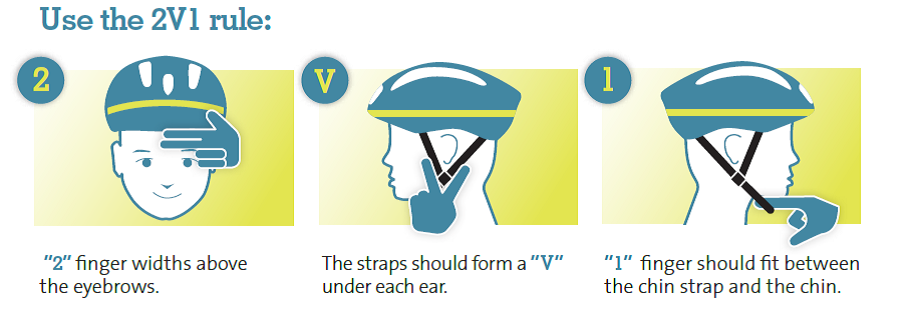
Adjust the helmet according to the 2-V-1 Rule 

2 – The helmet should be no more than two finger widths above the eyebrows. 

V– The straps should form a “V” under each ear. 

1 – One finger should fit between the chin strap and the chin. 

Straps can loosen over time. Check the fit of your helmet and your child’s helmet regularly. 

Three illustrations demonstrating the 2-V-1 Rule.

Take care of your helmet

  • Be careful not to drop your helmet. 
  • Avoid storing it in a hot place like the trunk of your car since heat can break down the foam. 
  • Avoid applying stickers to your helmet as this can weaken the plastic. 
  • Replace your helmet at least every five years because the materials break down over time. Some manufacturers recommend replacing it every three years. 
  • Cycling helmets are designed to withstand one hard impact. If your helmet has been in a crash or has had a hard fall, replace it, even if it does not appear to be damaged. 
  • Follow the manufacturer’s recommendations for cleaning your helmet. 

Heartburn in Pregnancy

Heartburn is when you feel burning or irritation in your throat area (esophagus) from food and stomach acid coming back up from your stomach. It is very common during pregnancy. Heartburn is caused by hormone changes and the pressure of your growing baby on your stomach. There are a few things you can try to help you cope with heartburn during pregnancy. 

Food 

Avoiding certain foods can help make your heartburn less severe. However, the types of food that can make heartburn worse can vary a lot from person to person. 

You may want to try avoiding these foods to see if your heartburn improves: 

  • acidic food, such as citrus fruit and tomatoes 
  • spicy foods 
  • foods that are high in fat or fried 
  • food or drinks with caffeine such as coffee, tea or cola drinks 

You may want to try drinking milk to decrease the amount of heartburn you are experiencing. 

Lifestyle Changes 

There are also a few lifestyle-related changes you can try: 

  • Sit up during meals and stay sitting up for 45 to 60 minutes after eating. 
  • Avoid eating two hours before bedtime. 
  • Eat small, frequent meals throughout the day. Avoid eating large amounts of food at one time. 
  • Wear loose fitting clothes so there is less pressure on your stomach. 
  • Some heartburn medications are safe during pregnancy. Speak with your health-care provider to find out which medications to try. 

Resources

Baby-led Weaning

Baby-led weaning introduces your baby to solid foods by giving soft, cut-up finger foods starting at six months old. It began in the United Kingdom where weaning means “starting solids,” not stopping breast/chest or bottle feeding. It encourages babies to feed themselves. 

What are the benefits of baby-led weaning? 

  • Baby-led weaning lets babies hold onto soft strips or pieces of food and bring it to their mouth. 
  • Parents stay close to their babies while they are eating, but do not help them get food into their mouth. Parents can enjoy their own meal while keeping a watchful eye on their baby. 
  • Babies can feed themselves and there is no pressure from caregivers to eat. 
  • Babies are in control of feeding and can stop eating when they are full or continue to eat if they are hungry. 
  • Babies can use all five senses — taste, touch, smell, sight and hearing — to explore the food while eating. 

How do I start baby-led weaning safely? 

During meals, offer soft, cut-up finger foods that your baby can hold with a fist. At six months, babies use their whole hand to pick things up. Around eight or nine months, babies can pick things up with their thumb and pointer finger. If you want, you can help your baby use a spoon. Put infant cereal, mashed or minced food on a spoon and give the spoon to your baby to feed themself. 

Start with a variety of iron-rich foods such as meat, poultry, fish, tofu and beans. At first, babies may only eat a little and might play with the food. Eventually, babies will use their gums to break down the food into smaller pieces to swallow. 

What are some soft foods I can offer my baby? 

  • firm tofu, in pieces 
  • meatballs made from ground beef, chicken, turkey, lamb or pork cut in half (or ground meat formed into a finger shape) 
  • wedges of hard-boiled egg
  • strips of scrambled egg or omelet 
  • pieces of cooked or canned fish (remove bones) 
  • mashed chickpeas or beans 
  • soft-cooked vegetables, such as green beans, carrot strips or spears of broccoli 
  • strips of cheese 
  • mashed berries 
  • oven-baked sweet potato or potato fries without skin 
  • pieces of soft fruit such as banana, avocado or mango 
  • pancakes made with foods such as lentils, brown rice, infant cereal, quinoa or oats. See the recipe
  • pancakes made with grated zucchini or beets with flour and egg 
  • strips of wholegrain toast with very thinly spread nut butter or thinly spread hummus 

Did you know? 

Mashed foods can be put on a spoon or formed into a ball or finger shape. If foods are slippery, like cut-up fruit or mashed foods, roll them in dry infant cereal so they are easier to hold. 

Is there something wrong with feeding my baby with a spoon? 

Spoon feeding is a safe and reliable way of feeding your baby. But it is important to let your baby decide what to eat and how much to eat. Babies will be better eaters in the future if they are not forced to eat or denied food. Eat as a family and remember to offer more textures (such as minced, grated, diced, and finger foods) as soon as your baby is seven months. Let babies feed themselves by nine months. 

Did you know? 

You don’t have to choose one way of feeding your baby over another. If you try baby-led weaning, you can also feed some foods with a spoon at the same time. 

Concerns with Baby-led Weaning

To prevent choking: 

  • Give foods that are soft and can be mashed on the roof of a mouth with a tongue. 
  • Make sure the food pieces are longer than your baby’s hand. 
  • Toast bread and cut into strips. Do not give soft bread. 
  • Do not give hard vegetables or fruit. Cook until soft and cut into strips. 
  • Cut round or oval foods into smaller pieces or mash them with a fork (for example, cut grapes into quarters, mash kidney beans or berries). 
  • Always watch babies when they are eating. 

Did you know?

Babies may gag on food when they try to eat. This is part of learning to swallow. Gagging is not the same as choking. Choking blocks the airway. In babies, the gag reflex is closer to the middle of the tongue. This helps the baby spit or cough food out. 

  • Not eating enough iron-rich foods or calories for growth.  

This is because the variety and amounts of food that babies can feed themselves can be limited. Between six and eight months old, babies are still learning to eat. It takes time and practice. To help your baby get enough calories and iron, you can also feed some foods with a spoon. Try iron-fortified baby cereals, mashed beans and lentils, and minced meats. 

Parent Tips

Bottom Line 

No matter how you introduce solid foods, it is important to wait until your baby shows signs of developmental readiness, usually around six months old. Talk to your health-care provider if you are having trouble introducing solids. Ask if baby-led weaning may be a good option for your baby. 

Resources

If you have a nutrition or food question, call Dial-a-Dietitian Manitoba at 204-788-8248 in Winnipeg or 1-877-830-2892.  

Print Friendly – Baby Led Weaning 

What Canadian Pediatricians Say About Children and Mental Health

As a parent, you play an important role in your child’s mental health: 

  • You can promote good mental health by the things you say and do, and through the environment you create at home. 
  • You can also learn about the early signs of mental health problems and know where to go for help. 

How can I nurture my child’s mental health? 

Help children build strong, caring relationships: 

  • It’s important for children and youth to have strong relationships with family and friends. Spend some time together each night around the dinner table. 
  • A significant person who is consistently present in a child’s life plays a crucial role in helping them develop resilience. This person, often a parent or other family member, is someone your child spends a lot of time with and knows they can turn to when they need help. 
  • Show your children how to solve problems. 

Help children and youth develop self-esteem so that they feel good about themselves: 

  • Show lots of love and acceptance. 
  • Praise them when they do well. 
  • Recognize their efforts as well as what they achieve. 
  • Ask questions about their activities and interests. 
  • Help them set realistic goals. 

Create a safe, positive home environment: 

  • Be aware of your child’s media use, both the content and the amount of time spent on screens. This includes TV, movies, Internet, and gaming devices. Be aware of who they might be interacting with on social media and online games. 
  • Be careful about discussing serious family issues – such as finances, marital problems, or illness – around your children. Children can worry about these things. 
  • Provide time for physical activity, play and family activities. 
  • Be a role model by taking care of your own mental health. Talk about your feelings and make time for things you enjoy. 

How do I know if my child or youth has a mental health problem? 

All children and youth are different. If you’re concerned your child may have a problem, look at whether there are changes in the way they think, feel or act. Mental health problems can also lead to physical changes. Ask yourself how your child is doing at home, at school and with friends. 

Where do I go for help? 

There are many ways to help your child achieve good mental health. Sharing your concerns with the doctor is one of them. Talk to your child’s doctor: 

  • if the behaviours described above last for a while, or if they interfere with your child’s ability to function
  • if you have concerns about your child’s emotional and mental health
  • about your child’s behavioural development and emotional health at each well-child visit 

If your child or teen talks about suicide or harming themselves, call your doctor or local mental health crisis line right away. Supports are available 24/7.

For more information  

Reprinted with permission from the Canadian Paediatric Society