Heartburn is when you feel burning or irritation in your throat area (esophagus) from food and stomach acid coming back up from your stomach. It is very common during pregnancy. Heartburn is caused by hormone changes and the pressure of your growing baby on your stomach. There are a few things you can try to help you cope with heartburn during pregnancy.
Food
Avoiding certain foods can help make your heartburn less severe. However, the types of food that can make heartburn worse can vary a lot from person to person.
You may want to try avoiding these foods to see if your heartburn improves:
acidic food, such as citrus fruit and tomatoes
spicy foods
foods that are high in fat or fried
food or drinks with caffeine such as coffee, tea or cola drinks
You may want to try drinking milk to decrease the amount of heartburn you are experiencing.
Lifestyle Changes
There are also a few lifestyle-related changes you can try:
Sit up during meals and stay sitting up for 45 to 60 minutes after eating.
Avoid eating two hours before bedtime.
Eat small, frequent meals throughout the day. Avoid eating large amounts of food at one time.
Wear loose fitting clothes so there is less pressure on your stomach.
Some heartburn medications are safe during pregnancy. Speak with your health-care provider to find out which medications to try.
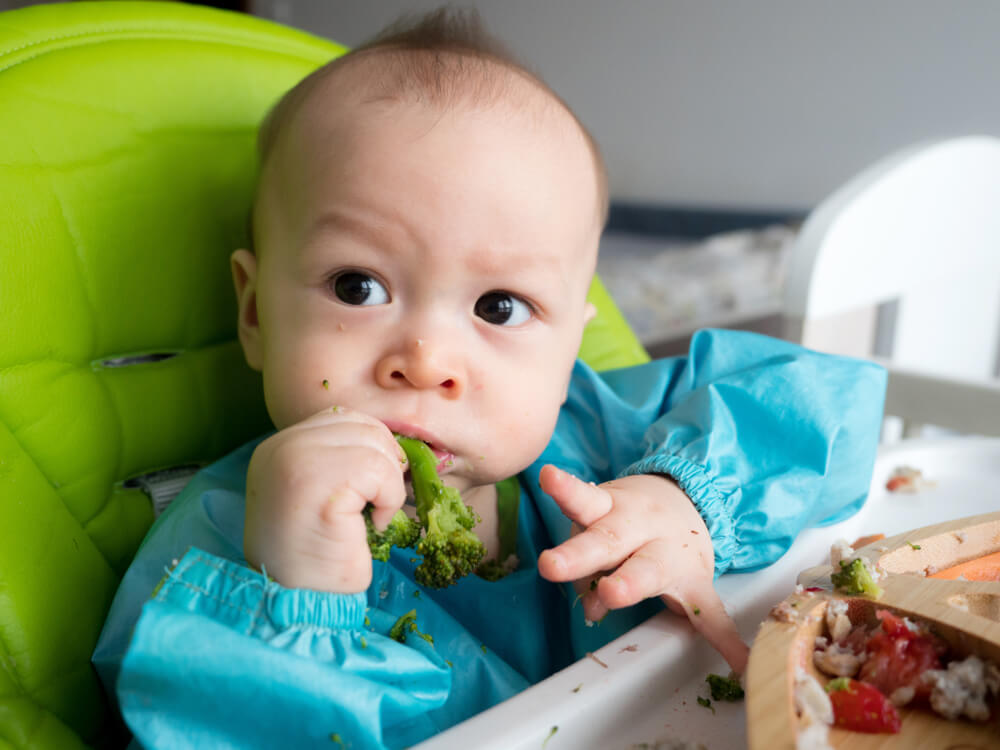
Baby-led weaning introduces your baby to solid foods by giving soft, cut-up finger foods starting at six months old. It began in the United Kingdom where weaning means “starting solids,” not stopping breast/chest or bottle feeding. It encourages babies to feed themselves.
What are the benefits of baby-led weaning?
Baby-led weaning lets babies hold onto soft strips or pieces of food and bring it to their mouth.
Parents stay close to their babies while they are eating, but do not help them get food into their mouth. Parents can enjoy their own meal while keeping a watchful eye on their baby.
Babies can feed themselves and there is no pressure from caregivers to eat.
Babies are in control of feeding and can stop eating when they are full or continue to eat if they are hungry.
Babies can use all five senses — taste, touch, smell, sight and hearing — to explore the food while eating.
How do I start baby-led weaning safely?
During meals, offer soft, cut-up finger foods that your baby can hold with a fist. At six months, babies use their whole hand to pick things up. Around eight or nine months, babies can pick things up with their thumb and pointer finger. If you want, you can help your baby use a spoon. Put infant cereal, mashed or minced food on a spoon and give the spoon to your baby to feed themself.
Start with a variety of iron-rich foods such as meat, poultry, fish, tofu and beans. At first, babies may only eat a little and might play with the food. Eventually, babies will use their gums to break down the food into smaller pieces to swallow.
What are some soft foods I can offer my baby?
firm tofu, in pieces
meatballs made from ground beef, chicken, turkey, lamb or pork cut in half (or ground meat formed into a finger shape)
wedges of hard-boiled egg
strips of scrambled egg or omelet
pieces of cooked or canned fish (remove bones)
mashed chickpeas or beans
soft-cooked vegetables, such as green beans, carrot strips or spears of broccoli
strips of cheese
mashed berries
oven-baked sweet potato or potato fries without skin
pieces of soft fruit such as banana, avocado or mango
pancakes made with foods such as lentils, brown rice, infant cereal, quinoa or oats. See the recipe.
pancakes made with grated zucchini or beets with flour and egg
strips of wholegrain toast with very thinly spread nut butter or thinly spread hummus
Did you know?
Mashed foods can be put on a spoon or formed into a ball or finger shape. If foods are slippery, like cut-up fruit or mashed foods, roll them in dry infant cereal so they are easier to hold.
Is there something wrong with feeding my baby with a spoon?
Spoon feeding is a safe and reliable way of feeding your baby. But it is important to let your baby decide what to eat and how much to eat. Babies will be better eaters in the future if they are not forced to eat or denied food. Eat as a family and remember to offer more textures (such as minced, grated, diced, and finger foods) as soon as your baby is seven months. Let babies feed themselves by nine months.
Did you know?
You don’t have to choose one way of feeding your baby over another. If you try baby-led weaning, you can also feed some foods with a spoon at the same time.
Concerns with Baby-led Weaning
To prevent choking:
Give foods that are soft and can be mashed on the roof of a mouth with a tongue.
Make sure the food pieces are longer than your baby’s hand.
Toast bread and cut into strips. Do not give soft bread.
Do not give hard vegetables or fruit. Cook until soft and cut into strips.
Cut round or oval foods into smaller pieces or mash them with a fork (for example, cut grapes into quarters, mash kidney beans or berries).
Always watch babies when they are eating.
Did you know?
Babies may gag on food when they try to eat. This is part of learning to swallow. Gagging is not the same as choking. Choking blocks the airway. In babies, the gag reflex is closer to the middle of the tongue. This helps the baby spit or cough food out.
Not eating enough iron-rich foods or calories for growth.
This is because the variety and amounts of food that babies can feed themselves can be limited. Between six and eight months old, babies are still learning to eat. It takes time and practice. To help your baby get enough calories and iron, you can also feed some foods with a spoon. Try iron-fortified baby cereals, mashed beans and lentils, and minced meats.
For ideas on how to incorporate starting solids with breastfeeding/chestfeeding or formula feeding, see our article on The Mess and Fun of Starting Solid Foods.
Bottom Line
No matter how you introduce solid foods, it is important to wait until your baby shows signs of developmental readiness, usually around six months old. Talk to your health-care provider if you are having trouble introducing solids. Ask if baby-led weaning may be a good option for your baby.
As a parent, you play an important role in your child’s mental health:
You can promote good mental health by the things you say and do, and through the environment you create at home.
You can also learn about the early signs of mental health problems and know where to go for help.
How can I nurture my child’s mental health?
Help children build strong, caring relationships:
It’s important for children and youth to have strong relationships with family and friends. Spend some time together each night around the dinner table.
A significant person who is consistently present in a child’s life plays a crucial role in helping them develop resilience. This person, often a parent or other family member, is someone your child spends a lot of time with and knows they can turn to when they need help.
Show your children how to solve problems.
Help children and youth develop self-esteem so that they feel good about themselves:
Show lots of love and acceptance.
Praise them when they do well.
Recognize their efforts as well as what they achieve.
Ask questions about their activities and interests.
Help them set realistic goals.
Create a safe, positive home environment:
Be aware of your child’s media use, both the content and the amount of time spent on screens. This includes TV, movies, Internet, and gaming devices. Be aware of who they might be interacting with on social media and online games.
Be careful about discussing serious family issues – such as finances, marital problems, or illness – around your children. Children can worry about these things.
Provide time for physical activity, play and family activities.
How do I know if my child or youth has a mental health problem?
All children and youth are different. If you’re concerned your child may have a problem, look at whether there are changes in the way they think, feel or act. Mental health problems can also lead to physical changes. Ask yourself how your child is doing at home, at school and with friends.
Where do I go for help?
There are many ways to help your child achieve good mental health. Sharing your concerns with the doctor is one of them. Talk to your child’s doctor:
if the behaviours described above last for a while, or if they interfere with your child’s ability to function
if you have concerns about your child’s emotional and mental health
about your child’s behavioural development and emotional health at each well-child visit
If your child or teen talks about suicide or harming themselves, call your doctor or local mental health crisis line right away. Supports are available 24/7.
If you need more information and help finding resources, call Health Links-Info Santé at 204-788-8200 or toll-free at 1-888-315-9257. You can speak to a nurse 24/7 in over 100 languages. They can answer your health questions and help you find health services in your community.
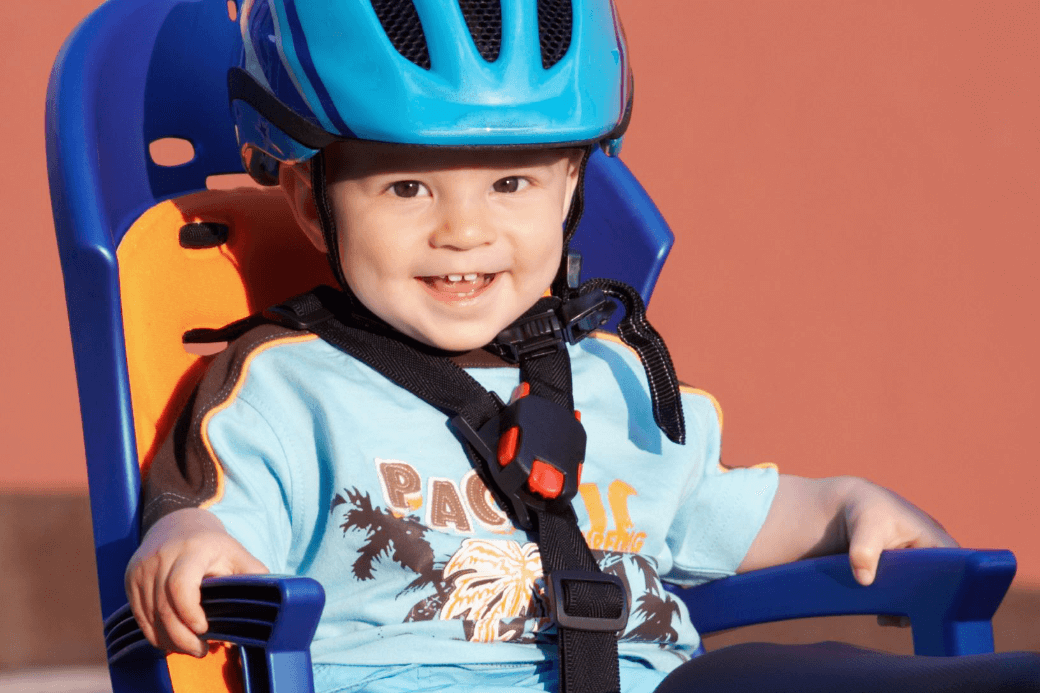
Bike helmets are important. In a crash, a helmet can reduce the risk of a serious head injury by up to 85 per cent. By law, all Manitoba cyclists under 18 years of age must wear a bike helmet. This includes infants and toddlers riding in a bike trailer or bike carrier and while riding on a tricycle or a push bicycle.
When shopping for a helmet for your child, look for one that:
is recommended for cycling. Look for a bike helmet or a multi-sport helmet that it is approved for cycling.
is certified by organizations such as the Canadian Safety Association (CSA), Consumer Product Safety Commission (CPSC), American Society for Testing and Materials (ASTM), Snell, European Standards (EN) or Australian/New Zealand Standard (AS/NZS).
fits the shape and size of your child’s head.
is adjustable to make a snug fit.
is comfortable and that your child likes.
Bicycle helmets for infants/toddlers
It can be challenging to find a helmet small enough to fit a young child. Look inside the helmet and on the package to see the size range of the helmet. The Consumer Product Safety Commission (CPSC) introduced new standards for children over one year of age where the helmets are designed to fit smaller heads.
How to fit your child’s helmet
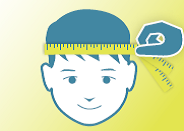
Use a tape measure to find your child’s head size. The helmet packaging will tell you the size range that it fits.
Go by the head measurement, rather than the child’s age. While the smallest helmet fits the average six- to eight-month-old, it may be too large for older toddlers who are small for their age or born prematurely (early).
Straps can loosen over time. Check the fit of your child’s helmet regularly and adjust the fit as needed.
Choose a helmet that fits snugly. Buy the size that fits right now, not a larger helmet for your child will grow into.
Use the sizing pads or adjustable band to fit the helmet to your child’s head. The helmet fits properly when:
It does not wobble from side to side, or tilt from front to back.
It does not move when your child shakes his/her head in any direction.
The helmet stays level across the forehead just above the eyebrows.
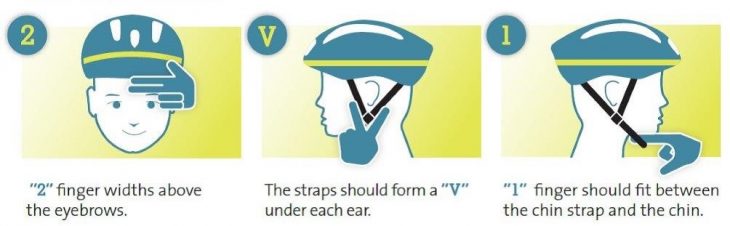
Adjust the helmet according to the 2-V-1 Rule
2 – The helmet should be no more than two finger widths above the eyebrows.
V– The straps should form a “V” under each ear.
1 – One finger should fit between the chin strap and the chin.
Straps can loosen over time. Check the fit of your helmet and your child’s helmet regularly.
Take care of your child’s helmet
Take care of the helmet so it will continue to offer good protection.
Cycling helmets are intended to withstand one hard impact. Replace the helmet if it has been in a crash, or has had a hard fall, even if it does not seem to be damaged.
Do not drop the helmet as this can cause damage.
Avoid storing it in a hot place like the trunk of your car since heat can cause the foam to deteriorate.
Do not apply stickers to the helmet as this can weaken the plastic.
Clean the helmet following the manufacturer’s instructions.
Replace helmets every three to five years because they deteriorate over time.
Swaddling can get in the way of mother-baby bonding and newborn feeding
Skin-to-skin contact between mother and baby has many benefits. It helps you develop your relationship with your baby, helps reduce your baby’s stress, promotes more restful sleep and helps with breastfeeding.
Tight swaddling can be risky
Tight swaddling can interfere with breathing and can even lead to pneumonia. Your baby must have enough room for their chest to move.
It can cause long-term hip problems. Your baby must have enough room to freely move the hips and legs.
Swaddling for sleep may result in sudden infant death
Loose fabric can cover baby’s face and cause suffocation.
If the baby becomes unwrapped, the fabric can become wrapped around baby’s neck and cause strangulation.
The baby may roll onto their stomach and be unable to roll back.
Babies wrapped in blankets or heavy fabrics can get too hot, which increases the risk of Sudden Infant Death Syndrome (SIDS).
Sleeping with a baby on a bed or couch greatly increases the risk of sudden infant death and suffocation. This risk is even higher when a baby is swaddled.
What are the reasons for swaddling?
If you’ve tried to soothe your crying baby by feeding, changing, and cuddling and your baby still isn’t comforted, you might try swaddling to calm them.
Healthcare providers may recommend swaddling during bottle feeding for babies who are born prematurely, who become upset or distracted when feeding, who have a very low birth weight, or who have trouble gaining weight.
Swaddling can provide pain relief for infants. Your doctor or nurse might swaddle your baby for needles or other painful procedures.
Choose a wrap that is:
Free of drawstrings, ribbons, cords or tight elastic.
Free of buttons, snaps or decorations which could become loose and cause choking.
Made of breathable fabric such as light cotton with a loose weave. Do not use a heavy blanket for swaddling.
Choose the right swaddling technique for your baby’s age
For younger babies (about 0-3 months old) wrap the arms in the swaddle with baby’s elbows bent, and hands close to the chin.
For older babies (about 3-6 months old and babies who can roll) leave their arms free.
How to safely swaddle baby
Dress your baby in a light sleeper or undershirt to prevent overheating.
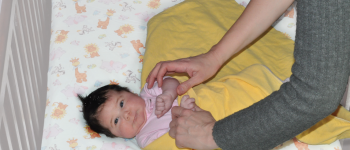
1. Spread the wrap out flat with one corner folded down. Lay baby face-up with baby’s head and neck above the folded corner.
2. Bring baby’s hands together over the chest. Bring one side of the wrap over top of the arms and tuck it beneath the baby.
3. Fold the bottom of the wrap up, leaving room for your baby’s feet to move freely. The hips and knees should be a little bent and have room to move.
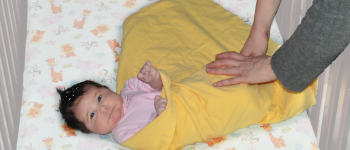
4. Bring the second side of the wrap across the baby, tucking the end behind baby.
Leave your baby’s hands free so they can show you when they are hungry.
Check that the swaddle is not tight: two fingers should fit between the wrap and your baby’s chest.
If your baby is sweating, they are too warm. You need to remove the swaddle.
Your baby is now ready to be held for comfort. Swaddled babies must never be placed on their sides or stomachs, even for a minute. Stop swaddling baby when your baby can roll over or is able to unravel the wrap. Loose fabric creates a suffocation or strangulation risk.
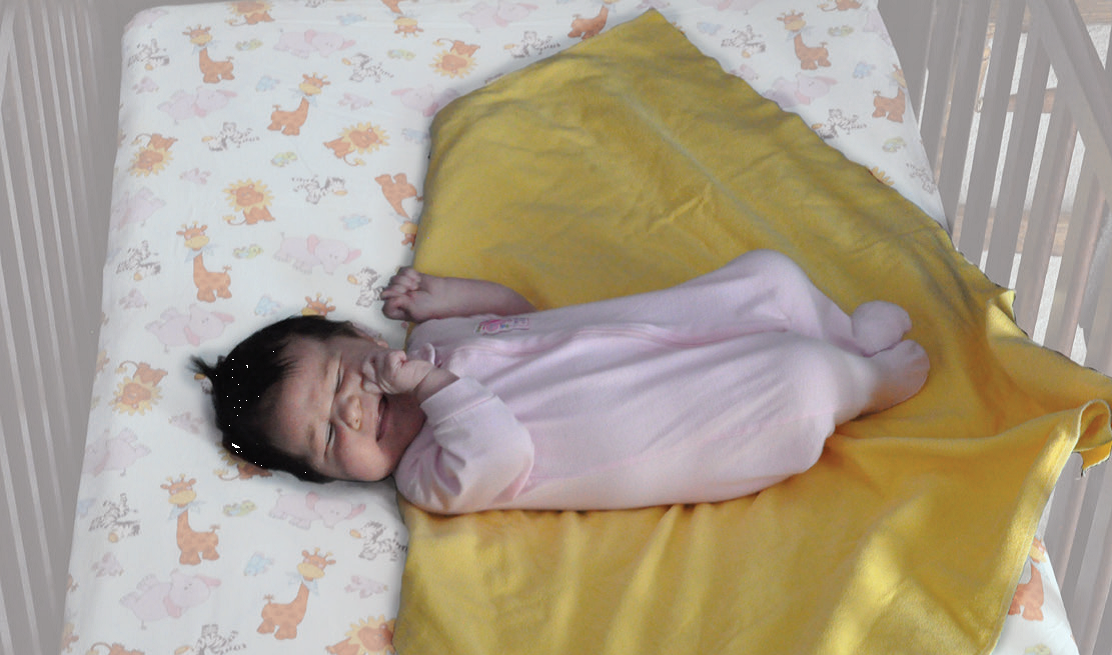
If your baby likes the “tucked in” feeling:
Lay baby on their back with feet near the bottom of the crib.
Place blanket so that it is no higher than baby’s armpits.
Tuck the blanket into the sides and bottom of the crib.
Booster seats and car seats help keep your child safe in a motor vehicle.
In Manitoba, all child passengers must ride in a child car seat or booster seat until they are at least:
145 centimetres (four feet nine inches) tall) OR
36 kilograms (80 pounds) in weight OR
nine years of age
When it comes to seat belt safety, your child’s height is the most important factor to consider.
Only move your child to a booster seat once they have outgrown the height or weight limit of the forward-facing car seat.
Did you know?
All children under 13 years of age should ride in the back seat of the vehicle.
How do booster seats work?
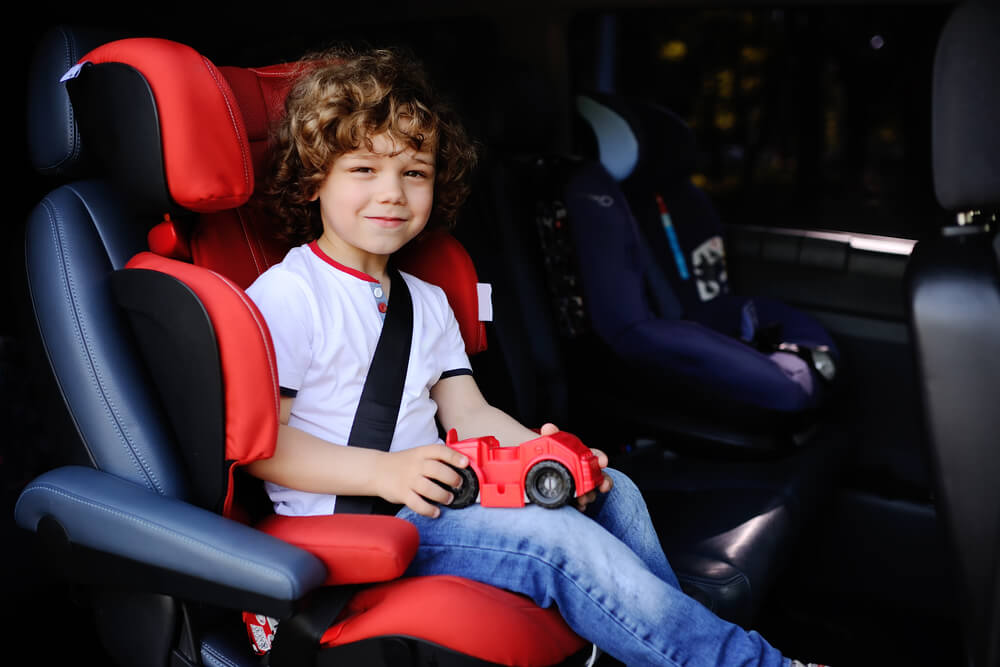
Your vehicle’s lap and shoulder belts (seat belts) are designed for adult bodies. Because children are too small for the seat belts to fit properly, they are at risk of serious injury without a booster seat.
Booster seats position the vehicle’s lap and shoulder belts properly over your child’s body. Most booster seats raise the child up so that the lap belt and shoulder belt are positioned across their hips and collar bone. Some newer models work by positioning the car seat belts rather than raising the child up.
Without a booster seat, the shoulder belt goes across the child’s neck and the lap belt rides over the child’s tummy. In a crash, this can cause serious injuries to the neck, spine and abdomen.
Note: Other videos may be recommended by the host channel (e.g. YouTube, Vimeo). These suggestions may be based on your personal search history and other factors. The Manitoba Government does not control these suggestions and is not responsible for and may not endorse the content.
Which booster seat should I choose?
If your child is in a convertible forward-facing car seat that can also be used as a booster, follow the car seat manual on how to use it.
If are buying a booster seat, you can choose:
a high-back booster seat that raises your child up and positions the lap belt and shoulder belt correctly. Some high back boosters have a head and neck support that can be adjusted as your child grows. These are good for children who tend to fall asleep in the car. High back booster seats are recommended for use in vehicles that don’t have head rests.
a no-back booster that raises your child up so that the lap and shoulder belts are positioned correctly.
belt positioning seats are newer products which position the lap and shoulder belt without raising your child up.
Look for a booster seat that has a higher weight limit. Some seats are made for children up to 55 kilograms (120 pounds).
Look for Transport Canada’s National Safety Mark on the booster seat. Booster seats sold in the United States will not have this seal and are not approved for use in Canada.
Safety Tip
Make sure that the vehicle seat or headrest is high enough to reach at least the top of your child’s ears. This helps protect your child’s head and neck in a crash. If the vehicle seat back and head rest are not high enough, raise the head rest or use a high back or belt positioning booster seat.
Are second-hand (used) booster seats safe?
They can be. Avoid a used booster seat if:
it has been in a crash, or you don’t know if it has been in a crash
it is past the expiry date
it has missing parts
it has visible damage or cracks
How do I install my booster seat?
Follow the manufacturer’s instructions for how to install and use the booster seat.
The shoulder strap should fit across your child’s chest and shoulder (collarbone). The lap belt should go across the hips – not the abdomen.
All children under 13 years of age should ride in the back seat of the vehicle.
Safety Tips
Follow the owner’s manuals for your vehicle and booster seat for proper installation.
Always use the lap and shoulder belt with a booster seat. Never use it with just a lap belt.
Never allow your child to travel with the shoulder belt behind their back.
Avoid products that are sold separately from the booster seat (seat protectors, seat belt covers). These could affect how well the booster seat protects your child in a crash.
When the booster seat is not being used, buckle it up or take it out of your vehicle. If you are in a crash or make a sudden stop, a loose seat can injure people in the vehicle.
How will I know if my child is ready for a seat belt?
In Manitoba, the law states that a child is ready for a seat belt when they are:
145 centimetres (four feet nine inches) tall) OR
36 kilograms (80 pounds) in weight OR
nine years of age
When it comes to seat belt safety, your child’s height is the most important factor to consider.
Note: Other videos may be recommended by the host channel (e.g. YouTube, Vimeo). These suggestions may be based on your personal search history and other factors. The Manitoba Government does not control these suggestions and is not responsible for and may not endorse the content.
Take the Seat Belt Fit Test to see if your child can use a seat belt:
Have your child sit with their back against the car’s seat back – no slouching. Check the fit:
Back: Is their back against the seat back?
Knees:Do they bend comfortably over the edge of the seat?
Lap belt: Does it rest on the top of the thighs and not over the stomach?
Shoulder belt: Is it centred on the child’s collarbone between the neck and the shoulder, and not across the neck or chin? Never place the shoulder belt behind the back or under the arm as this can result in life-threatening injuries.
Can your child remain seated in this position without slouching for the entire trip?
A child can ride safely without a booster when you can say YES to all these questions. If any of these steps are not met, your child should be in a booster seat.
Safety tip
Every vehicle is different. Your child might pass the seat belt fit test in one vehicle but need to use a booster seat in different vehicle.
A fall can happen in a blink of an eye. The good news is that you can help prevent falls and injuries if you know what puts your child at risk.
Newborns
Did you know that being dropped is the most common cause of fall-injury in newborns?
In the hospital
Hospital staff will work with you to make sure that you and your baby have lots of opportunity to bond and breastfeed/chestfeed, while keeping your baby as safe as possible.
After delivery, exhaustion or pain medication can put new parents at risk of accidentally dropping their baby. Tired new parents may fall asleep while holding or feeding their baby and lose their grip.
You can help keep your baby safe in the hospital by:
always putting your baby on their back in the bassinet to sleep
telling your nurse if you are dizzy or drowsy
being aware of wet floors, spills or equipment which may cause you to slip or fall
not carrying your baby in your arms when you are outside your room.
always transporting your baby in the bassinet. This is a hospital policy.
In the home
New parents are often very tired, may be multi-tasking and can be distracted. You can help keep your baby safe at home by:
For sleep:
Lay your baby on their back in the crib if you are feeling sleepy so you don’t fall asleep with them in your arms.
After feeding your baby at night, put them in their crib before you fall asleep.
Around home:
Wear non-slip socks or shoes in the house to avoid slipping while carrying your baby.
Be careful when using the stairs while holding your baby.
A wet baby is a slippery baby so take extra care at bath time.
If you are carrying your newborn in a car seat, be sure the harness straps are securely fastened.
If using a sling, carrier or wrap to carry your baby, make sure your child is supported and snug. Have a good hold on your baby before you bend over.
When you are not holding your baby, it is best to put them in a crib, cradle, bassinet or playpen or on the floor. Babies can fall from beds, couches and other furniture.
Preventing falls in the first year
Stay one step ahead of your child to help keep them safe.
Your baby will grow and develop so much in the first year. Their abilities will change quickly. Each new movement can come with new risks. As your child grows and learns to walk, falling over is normal. But falls from heights can result in an injury. Some examples include falling off furniture, downstairs and out of windows.
Your baby will soon be…
To keep your baby safe…
Rolling over
Always keep a hand on your baby when on a change table, sofa, bed or other raised surface.
Pulling up
Lower the crib mattress before baby can push up on hands and knees to prevent from them from falling out of the crib.
Crawling
Install wall-mounted gates at the top of the stairs and pressure-mounted gates at the bottom of the stairs.
When using baby equipment
Always use the safety straps on strollers, infant chairs, swings, highchairs, kitchen booster seats and change tables.
Avoid putting your child in a bouncy chair, baby carrier or car seat, on a table, counter or other raised surface.
It is not safe to leave babies unattended in car seats, carriers or strollers. Babies should be taken out of a car seat once you have reached your destination. Place your baby on a safe sleep surface, such as a Health Canada-approved crib, cradle, or bassinet – even if they are only napping.
Don’t use a wheeled baby walker. Wheeled walkers are banned in Canada because babies have died or were seriously injured falling downstairs while using them.
Toddlers
Toddlers learn through play, exploring and mimicking. Keep teaching your child about safety, but remember your child is still learning and won’t always remember to follow the rules. Your supervision is very important in keeping your toddler safe. Give your toddler a safe place to learn, explore or try out something new. Here are some tips to help prevent the most common causes of toddler falls.
Your child will soon be able to…
To keep your child safe…
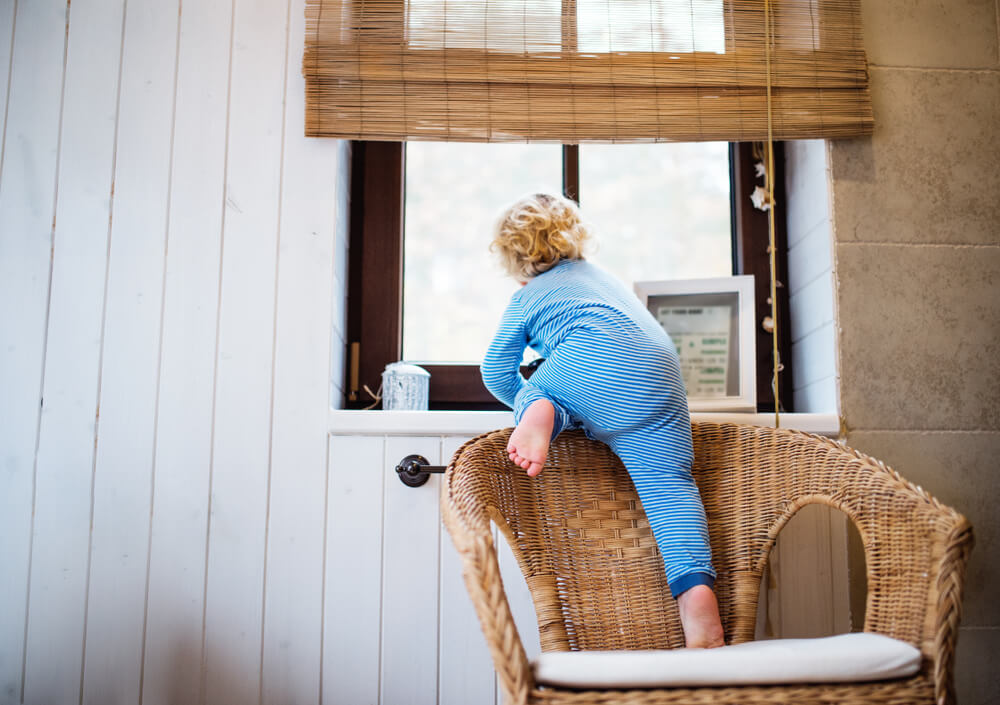
Climb up stools, chairs or other furniture
Keep drawers closed so they cannot be used to climb onto countertops or furniture.
Keep chairs, stools and other furniture away from windows, countertops and cupboards.
Secure televisions, bookshelves and furniture to the wall so they can’t tip over if your child tries to climb them.
Climb out of crib
Move your child to a toddler bed or mattress on the floor once they can climb out of their crib or they are taller than 90 centimetres (35 inches).
Climb near windows and balconies
Use window locks on all upper-floor windows. Window screens will not protect young children from falling out.
Move furniture such as change tables and dressers away from windows so children don’t have easy access.
Practice balcony safety:
Always supervise your child.
Lock door to balconies when not in use.
Move balcony furniture that could be used to climb over the railing.
Climb stairs
Once your child can open or climb over the stair gate, take the gates down
Teach them to go up and down the stairs using the handrail.
Climb on Beds
Do not let your child on the bed or couch by themselves.
Children under the age of six should not sleep or play on the top bunk of a bunk bed.
Play
Follow age recommendations on community play equipment.
Children under five should not play on equipment higher than five feet off the ground unless they are within your arm’s reach.
All raised play structures should be on a soft surface such as pea gravel, sand or wood chips.
Your child should wear a properly fitted helmet when sledding, skating or riding a tricycle or when a passenger on a bike carrier or trailer.
Some pregnant people feel movement as early as 13 to 16 weeks from the start of their last period. By 24 weeks, almost all pregnant people will feel their baby’s movements.
What do early fetal movements feel like?
Some people explain the movements as butterflies fluttering. In the beginning you may be wondering if those first gentle taps are gas or hunger pains. You will start to recognize the movements once you are feeling them regularly. You may be able to feel your baby kicking, rolling or stretching. Once you can feel your baby moving, it will probably be a few weeks more until your partner can feel your baby moving too.
When should I start checking my unborn baby’s movements?
Every baby will have times when they are more or less active, but the timing of increased movement tends to be consistent. Some babies may be more active in the morning or evening only. If you’re counting movements, try to do it at the same time each day. If you noticed any changes in your baby’s usual activity level, especially in the third trimester, you can do a kick count at any time.
Your primary care provider might want to watch you more closely if you have had a previous stillbirth or if you are currently experiencing complications by conditions such as high blood pressure or diabetes. If this is the case, count your baby’s movements every day starting at around the 26th week of your pregnancy.
How do I check my baby’s movements?
Lie down on your left side and pay attention to the baby’s movements. Put your hands on your tummy to feel for them.
You should feel at least six or more moves, kicks, rolls, flutters or stretches in two hours.
What should I do if my baby is not moving or moving less than six times in two hours?
You should call your primary care provider or go to the hospital, nursing station or healthcare centre you will be delivering at. Go the same day.
Bilirubin is a yellow pigment that is released when the liver breaks down red blood cells.
Because your baby’s liver is still immature, it cannot remove bilirubin fast enough, so it builds up in the blood. This causes your baby’s skin to turn yellow (known as jaundice).
As your baby eats (breastfeeds/chestfeeds or formula feeds), the bilirubin is removed from their body when they poop and pee.
Where will I see the jaundice on my baby?
Jaundice usually starts on the face and eyes. Then it spreads to your baby’s body and finally to their arms and legs. Most cases of jaundice are normal and not harmful and go away within a few days or weeks with no special treatment.
How do I prevent jaundice?
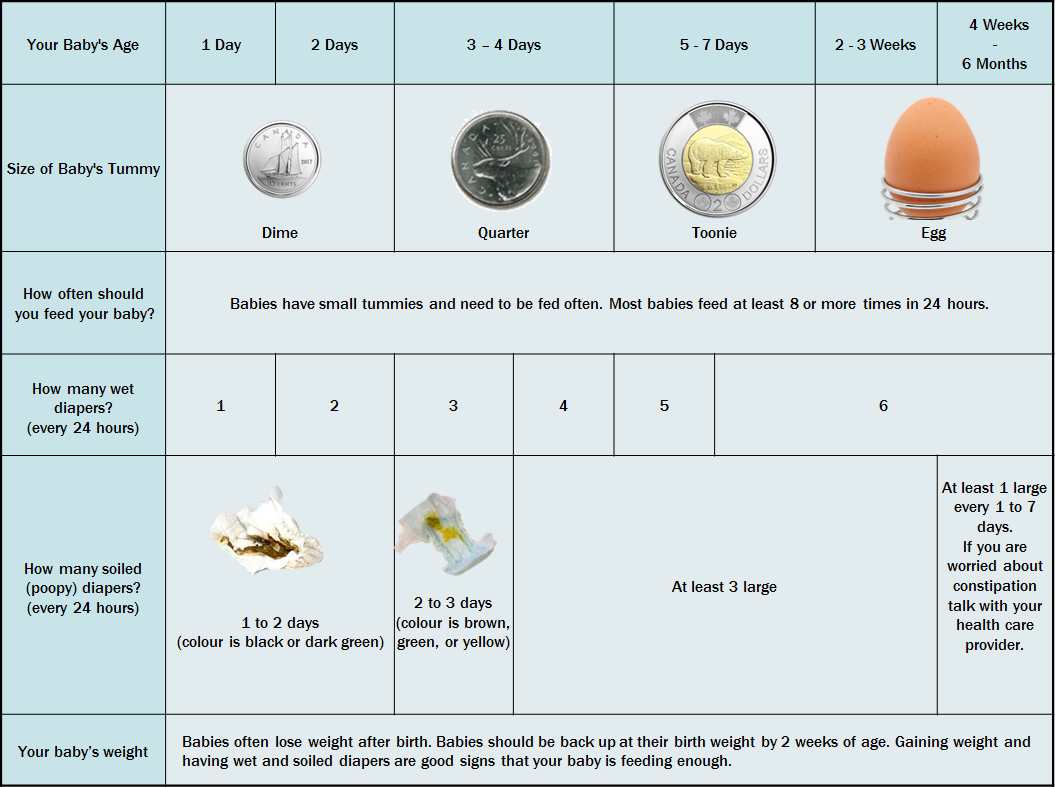
Your baby gets rid of the bilirubin through pooping and peeing.
For your baby to poop and pee, they need to be feeding well.
See the chart below for how often your baby should be pooping and peeing.
How do I know if my baby has a high bilirubin level?
Bilirubin levels are measured with a blood test or with a light machine that measures bilirubin in the skin.
Pediatricians recommend that babies should have their bilirubin levels checked before they go home.
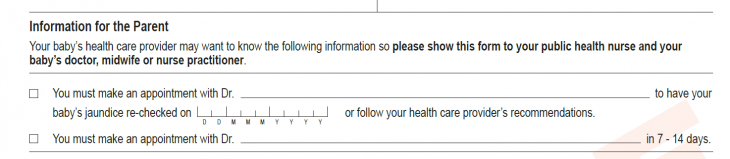
Parents may be given a copy of a form that looks like this Discharge Information – Newborn Jaundice form. It shows what the bilirubin level was in the hospital and if it needs to be checked again. Some babies need to have another blood test after they get home. If you were not given any instructions about the jaundice form, call your doctor, public health nurse or other health-care provider.
If the hospital is using a form like this, your health-care provider will check one of the boxes on the form which explains what you need to do. See below for what the boxes look like.
When should I be concerned about my baby’s jaundice? What should I do?
A high bilirubin (jaundice) level can be dangerous. Call your baby’s health-care provider and ask for a same-day appointment if your baby:
starts to turn yellow (skin, whites of the eyes, arms and legs) after you get home
is getting more yellow or orange (skin, whites of eyes, arms and legs)
will not breastfeed/chestfeed or bottle feed
is too sleepy to feed for two or more feeds
is sleepy/difficult to wake up
If you cannot get a hold of your baby’s doctor that day, contact your public health nurse or go to your nearest emergency department, health centre or nursing station.
Did you know?
Breastfeeding/chestfeeding is a learned skill for parents and babies. It requires patience and practice. Get help right away if breastfeeding/chestfeeding is not going well for you and your baby.
You are leaving the Parenting in Manitoba website. The Government of Manitoba is not responsible for the content or security of third-party websites. Go BackContinue
Vous quittez à présent le site Web Être parent au Manitoba. Le gouvernement du Manitoba n’est pas responsable du contenu ni de la sécurité des sites Web tiers. RetourneContinuer